My Father's Shadow [TIFF 2025]: A love letter to an absent father
4 min to read
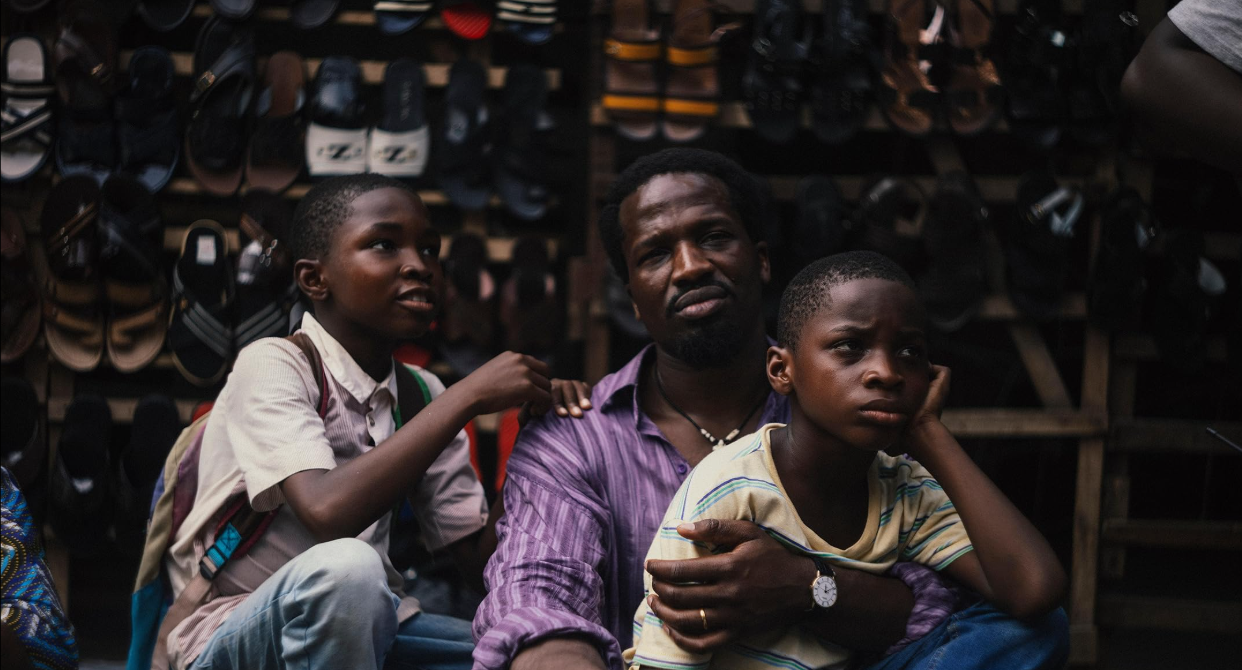
Set in 1993 in the city of Lagos, Nigeria, during a national election that would've signified a shift from military rule to democracy. Two young brothers, Remi and Akin, accompany their father to the city in order to collect his delayed salary. The whole film takes place during one day, in which we get a few glimpses of their lives with short but impactful dialogues between father and sons.
The tone is masterfully crafted but never forced. Director Akinola Davies Jr. is gentle in his style, inviting us into the emotional side of his world through beautiful use of close shots — the camera often lingers on dad's eyes, his pronounced frown and subtle expressions suggesting pain and longing. Other times, the camera waywardly dances around, accompanied by droning and intermittent piano notes with playful reverberations that, in my mind, signifies a slow reconstruction of a memory. It often pans to the contrasting color and decay in the streets, then to the sky, where a group of circling birds would follow the father and his sons throughout the film, never quite leaving us at ease.
The subtlety of the cinematography somewhat clashes with its predictible tragedy at the end, yet the tone of the film is simply hypnotizing, and the chemistry between father and sons keep us invested all the way to the end. The oncoming death is strongly hinted, quite literally through multiple shots of lingering birds in the sky that never fail to draw Remi's and Akin's attention. As the film is drawn loosely from director's own experiences, I couldn't help but think that this was a love letter to his own father.
In this sense, the film acts as a "slow recognition" — as Jason Ryle mentions in the official TIFF synopsis — of the often absent father through the eyes of his sons. "The difficult work of seeing someone clearly, perhaps for the first time, and finding something in them more profound than expected".
The father's impenetrable appearance is gradually pierced and he opens up as the day goes on, for what seems like the first time in his life, to his own sons.
One particular scene comes to mind, when they reach the beach and Folarin (the father) tells his eldest son the story of his own childhood, when his older brother drowned and how years later he had dreamt him in his sleep, always waking up at the moment that his dead brother was trying to tell him something. Folarin was then saddened by how no one talked about his older brother after he died, how "he was forgotten, as if he never existed".
That something that could never be told in his sleep may symbolize Folarin's own distance from his sons, it was — as he saw it — the necessary outter layer of hardened masculinity required in the politically unstable Nigeria of the 90's. Yet in the same scene Folarin tells his son that his own father was wrong in thinking that the only thing he could be is a provider.
As the waves are slowly rolling onto the shore, the eldest son asks his often absent father,
“Daddy, if you say that you love us and God loves us, then does that mean that people who love us are always far away?”
The father fell silent. He did not know what to reply.
Rating: 9/10