Edgar Allan Poe: The Pit and the Pendulum - short story review
A true horror masterpiece. Such a simple concept,—a man wakes up in a prison and tries to grasp how he ended up in it—yet written so chillingly.
There’s nothing we know about the protagonist, except that he wakes up in a dark room and is barely able to stay conscious from exhaustion:
“I was sick — sick unto death with that long agony; and when they at length unbound me, and I was permitted to sit, I felt that my senses were leaving me.”
Throughout the story, Poe’s pure physicality of the prose stands out; for example, the way he describes the protagonist struggling to come to his senses after being unconscious:
“Very suddenly there came back to my soul motion and sound — the tumultuous motion of the heart, and, in my ears, the sound of its beating. Then a pause in which all is blank. Then again sound, and motion, and touch — a tingling sensation pervading my frame. Then the mere consciousness of existence, without thought — a condition which lasted long. Then, very suddenly, thought, and shuddering terror, and earnest endeavor to comprehend my true state. […] And now a full memory of the trial, of the judges, of the sable draperies, of the sentence, of the sickness, of the swoon.”
Or how he describes his fear of the dark and the subsequent paranoia:
“My worst thoughts, then, were confirmed. The blackness of eternal night encompassed me. I struggled for breath. The intensity of the darkness seemed to oppress and stifle me. The atmosphere was intolerably close. I still lay quietly, and made effort to exercise my reason. I brought to mind the inquisitorial proceedings, and attempted from that point to deduce my real condition. The sentence had passed; and it appeared to me that a very long interval of time had since elapsed. Yet not for a moment did I suppose myself actually dead. Such a supposition, notwithstanding what we read in fiction, is altogether inconsistent with real existence; — but where and in what state was I?”
This paranoia, of not being able to distinguish the “fiction” that our mind creates due to the unknown from the real facts of the situation is very Lovecraftian, and since Poe lived before H.P. Lovecraft, it’s clear where the latter’s inspiration came from.
This particular passage in which the protagonist tries to distract himself from his fear by trying to be rational and studying his surroundings particularly reminded me of Lovecraft:
“I presumed the dungeon to be fifty yards in circuit. I had met, however, with many angles in the wall, and thus I could form no guess at the shape of the vault; for vault I could not help supposing it to be. I had little object — certainly no hope in these researches; but a vague curiosity prompted me to continue them.”
It’s very similar to Lovecraft’s “The Temple”:
"Though I knew that death was near, my curiosity was consuming" (H.P. Lovecraft, The Temple)
As the protagonist studied his prison in complete darkness he almost fell into a deep pit that stood in the middle of his cell:
“I put forward my arm, and shuddered to find that I had fallen at the very brink of a circular pit, whose extent, of course, I had no means of ascertaining at the moment. Groping about the masonry just below the margin, I succeeded in dislodging a small fragment, and let it fall into the abyss. For many seconds I hearkened to its reverberations as it dashed against the sides of the chasm in its descent; at length there was a sullen plunge into water, succeeded by loud echoes.”
He luckily escaped death, and it’s in this moment that he makes (somewhat strange) analogies to the alleged tortures of the Spanish Inquisition (is he a prisoner of the Inquisition?):
“And the death just avoided, was of that very character which I had regarded as fabulous and frivolous in the tales respecting the Inquisition. To the victims of its tyranny, there was the choice of death with its direst physical agonies, or death with its most hideous moral horrors. I had been reserved for the latter. By long suffering my nerves had been unstrung, until I trembled at the sound of my own voice, and had become in every respect a fitting subject for the species of torture which awaited me.”
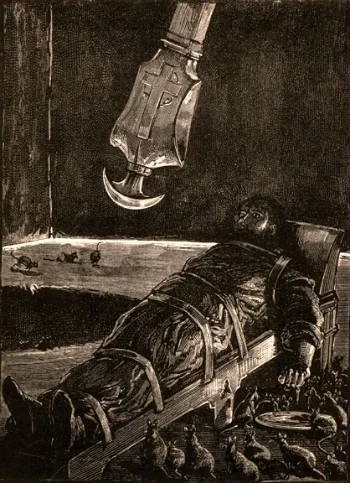
His suffering at the beginning is mainly psychological, due to the unknown and due to his weakened senses. But later in the story he wakes up to being strapped to a platform and discovers a pendulum with a sharp edge that swings above him and is dropping very slowly, so slowly that it seemed to him like days until it came close to him.
And again, observe the physicality of the horror, this in my opinion is what sets apart a good horror story from a mediocre one:
“Down — still unceasingly — still inevitably down! I gasped and struggled at each vibration. I shrunk convulsively at its every sweep. My eyes followed its outward or upward whirls with the eagerness of the most unmeaning despair; they closed themselves spasmodically at the descent, although death would have been a relief, oh! how unspeakable! Still I quivered in every nerve to think how slight a sinking of the machinery would precipitate that keen, glistening axe upon my bosom.”
This claustrophobia and anticipation of horror reminds of Kafka’s “In the Penal Colony”, which is arguably an even more disturbing story.
The psychological suffering is unrelenting as well, and it is curious how Poe chose “hope”—which is usually a positive thing—to be part of the horror here. As long as there’s hope, we’re terrified:
“It was hope that prompted the nerve to quiver — the frame to shrink. It was hope — the hope that triumphs on the rack — that whispers to the death-condemned even in the dungeons of the Inquisition.”
And ironically it is through the medicine of “despair” that he was able to finally think and deduce that the pendulum may cut his straps first before it got to his skin:
“I saw that some ten or twelve vibrations would bring the steel in actual contact with my robe, and with this observation there suddenly came over my spirit all the keen, collected calmness of despair. For the first time during many hours — or perhaps days — I thought. It now occurred to me that the bandage, or surcingle, which enveloped me, was unique. I was tied by no separate cord. The first stroke of the razorlike crescent athwart any portion of the band, would so detach it that it might be unwound from my person by means of my left hand.”
Then, as if the story wasn’t horrific enough, Poe introduces another detail that may explain the tragic fate of previous victims that fell in the pit:
"For many hours the immediate vicinity of the low framework upon which I lay, had been literally swarming with rats. They were wild, bold, ravenous; their red eyes glaring upon me as if they waited but for motionlessness on my part to make me their prey. 'To what food,' I thought, 'have they been accustomed in the well?'”
He escapes from the pendulum, as planned, but then the room starts heating up and starts closing in, pushing him more and more to the center where the pit was. The claustrophobia and the heat combine to bring him to what seems like the inevitable death, but then at the last moment he hears a roar of voices and trumpets, the walls retract, and an arm pulls him to safety. The French Army has captured the city of Toledo and the Inquisition has fallen into its enemies' hands:
“There was a discordant hum of human voices! There was a loud blast as of many trumpets! There was a harsh grating as of a thousand thunders! The fiery walls rushed back! An outstretched arm caught my own as I fell, fainting, into the abyss. It was that of General Lasalle. The French army had entered Toledo. The Inquisition was in the hands of its enemies.”
As some critics mentioned before me, historically speaking the story is inaccurate and there’s no proof as to the existence of these torture devices during the Inquisition. Still, a good horror story doesn’t have to be historically accurate in order to be terrifying, and my suspicion is that Poe did this intentionally.
Here’s what the Wikipedia page says about the facts:
“Poe makes no attempt to describe accurately the operations of the Spanish Inquisition, and takes considerable dramatic license with the broader history premised in this story. The rescuers are led by Napoleon's General Lasalle (who was not, however, in command of the French occupation of Toledo) and this places the action during the Peninsular War (1808–14), centuries after the height of the Spanish Inquisition. The elaborate tortures of this story have no historic parallels in the activity of the Spanish Inquisition in any century, let alone the nineteenth when under Charles III and Charles IV only four persons were condemned. The Inquisition was, however, abolished during the period of French intervention (1808–13). The original source of the pendulum torture method is one paragraph in the preface of the 1826 book The history of the Inquisition of Spain by the Spanish priest, historian, and activist, Juan Antonio Llorente, relating a second-hand account by a single prisoner released from the Inquisition's Madrid dungeon in 1820, who purportedly described the pendulum torture method. Most modern sources dismiss this as fantasy. One theory is that Llorente misunderstood the account he heard; the prisoner was actually referring to another common Inquisition torture, the strappado (garrucha), in which the prisoner has his hands tied behind his back and is hoisted off the floor by a rope tied to his hands. This method was also known as the ‘pendulum’.”
A short-story to remember, that’s for sure. And a good personal introduction into Edgar Allan Poe—what a mad lad.
Rating: 4/5