Steven Pinker: Enlightenment Now - book review
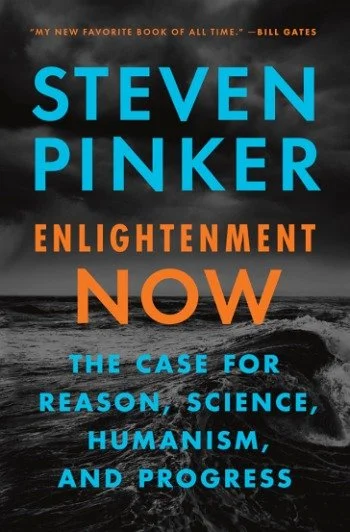
It’s an alright book, but it would be better if not for multiple platitudes and superficial analysis. The problem with books like these is that they are ambitious up to a fault. They allure readers with their breadth of topics, but they don’t go deep. They are, at its core, shallow. It’s filled with lots of stats and data which support Pinker’s argument: that capitalism, along with The Enlightenment idea of societies based on reason, have brought mostly good things to the world — economical prosperity brought less wars, better health and more choices for people; and reason has brought us universal values and modern institutions of law etc.
And yet I can’t be entirely sure that Pinker isn’t selecting the stats that defend his argument, I’m sure there is data suggesting the opposite (which wouldn’t be enough, in my opinion, to debunk Pinker’s position completely, but it would surely weaken it). That is, basically, my main complaint for this book, it all seems too optimistic and one-sided, and there is an argument to be made for more optimistic perspectives, among the doom and gloom that usually come with anything related to current events, yet, still, I’m left with the feeling that Pinker is trying to sell me the idea of Enlightenment, as strange as that sounds.
Pinker goes over some complex topics (like inequality, moral philosophy, religion) with so much confidence that one may wonder whether Pinker is a genius or just simply naive. I tend to believe the latter.
Pinker is too optimistic for my taste, but that doesn’t mean the current political and social discourse doesn’t need people like him — we need some opposition to the dreaded pessimists that are always plenty in any period in history.
Also, stats aren’t set in stone and they always change with time (sometimes drastically), and Pinker’s confidence is at times unfounded. Besides that, the book is a bit repetitive, a lot of filler chapters which could’ve been incorporated into shorter ones.
Here are some notes I took during reading (they’re not too organized, but you’ll get the general idea):
— On the positive effects of capitalism and Enlightenment ideas —
- Capitalism predominantly brought good things because of economic prosperity.
- We have less wars.
- Much less infant mortality.
- More choices in what to study and where to work.
- Much easier to travel; we’re not dependent on our country of origin as much as in the past.
- Global organizations for “checks and balances” have brought stability to our world (inspired by The Enlightenment and Kant’s “Perpetual Peace” essay).
- The Enlightenment brought reason to the forefront, and that’s a very good thing.
- Liberal democracy, fuelled by capitalism, is the most flexible system we have so far, and it’s one that opened up the most opportunities to the general public and also gave them universal human rights.
- There’s room for improvement, but we cannot forget the improvements that we already have.
- Our investment in the education of the general population (thanks to the ideas of The Enlightenment) has reaped great rewards.
- More access to good education = smarter population = less chances for a tyrant to gain political power = healthier democracy and so on (in a circle).
— On the negative effect of the extreme left on faculties —
- The extreme left (obsessed with political correctness) is as much to blame in our loss of belief in reason as the far right is to blame for the rise of demagoguery.
- The lack of bravery of university administrators (in confronting the extreme left) is concerning.
- In 1990, 42% of faculty (in US) were far left or liberal. In 2014, 60% were far-left or liberal.
- Pinker says that the liberal tilt is somewhat natural in faculties, and it’s desirable (but up to a point).
- Pinker criticizes the extreme left’s unhealthy involvement in social sciences and biology. They have compromised the quality of scientific research (it creates an echo chamber, which in turn narrows the sources of research).
— On the “post-truth” era —
- Pinker: “We are NOT in a post-truth era”. We cannot fight propaganda and disinformation with our own propaganda. Conspiracies and alternative facts are as old as the human race.
- The rising public interest in fact-checking platforms and websites prove that the resources for favouring truth are in play (even if they aren’t always used).
- Forecasters (people that predicted things in the future) with big ideas were the most wrong, from both sides of the political spectrum. They have an inspiring but misguided confidence. The more famous they were, the less accurate their predictions.
- We need to revise our concept of experts: we need more pragmatism.
- “Super forecasters” are not necessarily humble about their abilities, but they are humble about their beliefs (which are constantly tested); they are open-minded and are prone to change their beliefs if better data becomes available.
- Events are determined by multiple complex forces, not by a few “grand factors”.
— On Utilitarianism vs Deontology —
- Pinker is opting for humanism, which is in essence utilitarianism (or consequentialism).
- Deontology (morals based on intentions) usually, argues Pinker, has religious roots, which lots of times are dogmatic.
- Joshua Green, a neuroscientist, argues that many deontological arguments stem from tribalism and archaic social norms.
- History confirms that when diverse cultures have to find common ground, they converge towards humanism.
— On The Universal Declaration of Human Rights —
- The Universal Declaration of Human Rights — a humanist manifesto with 30 articles, was drafted in 2 years, thanks to Eleanor Roosevelt, chair of the drafting committee. In December 1948 it was approved without opposition by the UN General Assembly.
- Contrary to accusations that human rights are a parochial western creed, it was supported by India, China, Thailand, Burma, Ethiopia and 7 muslim countries, while Eleanor Roosevelt had to convince the american and British politicians to get behind it — the US was worried about its african Americans, and UK about its colonies. USSR, Saudi Arabia and South Africa abstained.
- The declaration was translated in 500 languages and it inspired most of constitutions that were drafted afterwards, together with many laws and international organizations.
— On the universality of Enlightenment morals —
- “The moral universe includes everyone who can think”. Pinker means by this that moral truths are self-evident as they are based on reason. Well, this seems like a statement by someone who didn’t read much philosophy. I think it’s more complicated than that, but this is a long topic and I won’t get into it this time.
- Thomas Nagel’s “validity of reason” argument: the act of arguing about reason presupposes the validity of reason. To negate logic you have to use logic.
Basically, Pinker says that arguments (based on reason) can be refuted or affirmed universally. But can they really?
Here’s my main question you can ponder on from this book:
Is Pinker’s “faith” in reason a bit unrealistic, or is it the best option that we have?
What if reason is insufficient to make us moral? Pinker’s answer is that in this case we need a “nudge” in the form of compassion, empathy, sympathy, gratitude, guilt, shame, forgiveness, righteous anger etc. In other words, sometimes reason needs the help of our emotional capacity. More than that, Pinker argues that “evolution selects for these moral sentiments” — a statement which shows very well the biggest problem I have with this book. Does evolution only select for moral sentiments? No, it doesn’t. It really depends on the context. Sometimes evolution selects for “dark triad” type of traits because they’re more advantageous in a specific environment. The truth is, actually, more complex. It’s not that simple. In a way I wish it was, Mr. Pinker, but I’m afraid it isn’t.
I subscribe to Pinker’s sentiment that reason is the only way we can move forward and solve societal issues. Before him, philosophers like Kant and Hegel argued more or less for the same thing (albeit by using way more obscure language and much more nuance). I just cannot share his unequivocal optimism. The book is filled with too much wishful-thinking and it’s just all a bit tiresome, I need my precious pessimism back, please :)
Rating: 2.5/5