Aldous Huxley: Brave New World - book review
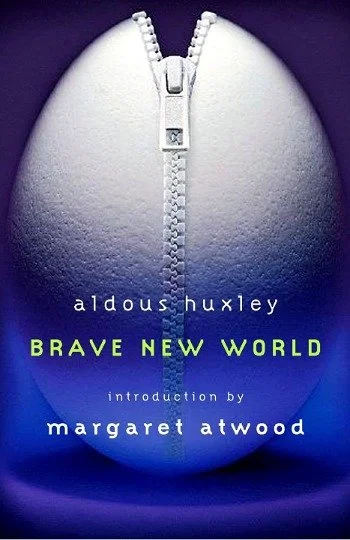
Dystopia? Utopia? It depends what you think of pleasure. In fact, I should say Pleasure with a capital P, because in this novel pleasure is raised to the level of religion, meaning that pleasure is seen as an end in itself, rather than as a means to an end.
This book is quite prophetic, as it has been said many times, and rightly so: almost a century ago, Huxley predicted how hedonism will take over the culture (sexual liberation and anti-monogamy propaganda), how we will be obsessed with sterilization (of our surroundings and of our thoughts), and most surprisingly, he kind of predicted cloning and gene editing (in 1932!).
Unlike Orwell’s 1984, people are controlled not by fear and punishment, but by giving people an excess of pleasure and comfort, or more specifically, by drugging the population with a substance called “soma”, which would take your troubles away and make you “happy”. So instead of trying to construct a sophisticated dystopia with “double-think” and "thoughtcrime” and other language-bending tools, Huxley simplified it with a simple drug. Take soma out, and Brave New World is kind of pointless, which may be a conscious choice by the author. Why? Well, because the language he used was quite…comical at times. It lacked the gravity and the terror that Orwell used in his dystopian world. Both novels are satires, but while 1984 is a satire of violent dictatorships (particularly of the 20th century), and thus, it had the appropriate seriousness to it, Brave New World is a satire of Utilitarianism combined with an extreme form of hedonism. In a way, it had to be more comical, more “pleasant”. But one may argue that Huxley is just a worse writer than Orwell. To which I would respond: both could be true at the same time. But that is, obviously, my subjective opinion.
Utilitarianism is a philosophy proposed first by the English philosopher Jeremy Bentham in the 18th century, but which was further formalized and completed by his nephew John Stuart Mill. In short, Mill’s moral theory was based on The Greatest Happiness Principle. What’s that, you ask? Here’s Mill’s explanation:
“The creed which accepts as the foundation of morals Utility, or the Greatest Happiness Principle, holds that actions are right in proportion as they tend to promote happiness, wrong as they tend to produce the reverse of happiness. By happiness is intended pleasure, and the absence of pain; by unhappiness, pain, and the privation of pleasure.”
So…you get it. I don’t think I need to explain to you how simplistic this principle sounds, and how easy it is to satirize it. Thus, this is what I think is Huxley’s goal in this book: satirizing the notion of utility, which is embodied in our almost blind trust in people that do science. But don’t get me wrong, I’m not saying that this novel is anti-science, not at all. It’s rather against putting science above human flourishing. In the foreword, 16 years after the publishing of the first edition, Huxley reflects:
“The Theme of Brave New World is not the advancement of science as such; it is the advancement of science as it affects human individuals.”
Thus, rather than a satire of the progress of science, Brave New World is a satire of how people in power use science, how they pervert its initial goal (of seeking truth by observing the evidence) and how they use it to control the masses rather than educate them (cynics may say it’s the same thing but that’s another story).
Overall, I can see why the book stood the test of time. Its predictions are quite surprising, provoking and relatively accurate. The funniest part is that it may have been too soft on the predictions. Huxley thought that our culture would degrade to that hedonistic extreme a few hundred years later, but only two decades after publishing the novel, Huxley seemed way more pessimistic:
“All things considered, it looks as though Utopia were far closer to us than anyone, only fifteen years ago [1932], could have imagined. Then, I projected it six hundred years into the future. Today it seems quite possible that the horror may be upon us within a single century.”
All in all, it’s a timeless modern classic, and yet, I was slightly disappointed. Not by the worldbuilding, but by the plot itself. The beginning (the scenes where the indoctrination and gene-editing process is explained) is really well written, the middle of the book though, in particularly the part about The Savage, is — to put it mildly —, sleep-inducing. Where Huxley excels is in explaining how the world is set up and how the dystopia actually works, but he fails in making us care about the characters. Bernard Marx seems like a cliché — a very smart man with physical deficiencies who has a dubious moral compass. Lenina seemed like a caricature rather than a real person (which might be intentional?) and John The Savage and his mother Linda were kind of pathetic. The only character who I thought was interesting was The World Controller of Western Europe, Mustapha Mond, whose philosophical dialogue with The Savage towards the end of the novel was probably the best part of the book, the part where there was some nuance to the (relatively) simplistic world of Brave New World — Huxley made us sympathize with Mustapha (the “bad” guy), and that instantly made the story more convincing, because I, as a reader, could almost justify the dystopia, and that is quite disturbing, to say the least.
The most convincing and heart-breaking part was where Mustapha Mond argued that heroism exists insofar as there is suffering and political instability. If you take that out of the equation, there is no opportunity for heroism to manifest in the world, and thus, people will stop appreciating the great dramas of humanity, like Shakespeare or famous greek tragedies, because they would become irrelevant:
“My dear young friend, civilization has absolutely no need of nobility or heroism. These things are symptoms of political inefficiency. In a properly organized society like ours, nobody has any opportunities for being noble or heroic. Conditions have got to be thoroughly unstable before the occasion can arise. Where there are wars, where there are divided allegiances, where there are temptations to be resisted, objects of love to be fought for or defended — there, obviously, nobility and heroism have some sense. But there aren’t any wars nowadays. The greatest care is taken to prevent you from loving anyone too much. There’s no such thing as a divided allegiance; you’re so conditioned that you can’t help doing what you ought to do. And what you ought to do is on the whole so pleasant, so many of the natural impulses are allowed free play, that there really aren’t any temptations to resist. And if ever, by some unlucky chance, anything unpleasant should somehow happen, why, there’s always soma to give you a holiday from the facts. And there’s always soma to calm your anger, to reconcile you to enemies, to make you patient and long-suffering. In the past you could only accomplish these things by making a great effort and after years of hard moral training. Now, you swallow two or three half-gramme tablets, and there you are. Anybody can be virtuous now. You can carry at least half your morality about in a bottle. Christianity without tears — that’s what soma is.” (p. 210).
It is hard to avoid the comparisons with 1984, and it’s hard for me to say that both are equally as good. No, while both of them excel in satirizing different aspects of human tendencies — fear and self-censorship (1984) and choosing pleasure (and stability) over freedom (Brave New World) —, Orwell’s novel seems more mature, not just by the tone and sophistication, but in the writing tools that he uses to make us care about the characters. Huxley’s world, on the other hand, lacks profundity and conviction, while still being an entertaining and prophetic satire. Nevertheless, both of them will remain in our modern folklore as touchstone dystopian novels which will be discussed for decades (or even centuries?) to come; and despite slightly criticizing its structure, I think where Brave New World may surpass 1984 is in the relevance of the warning it had for us: that seeking pleasure as an end goal may be the end of our civilization as we know it.
In Huxley’s words:
“A really efficient totalitarian state would be one in which the all-powerful executive of political bosses and their army of managers control a population of slaves who do not have to be coerced, because they love their servitude.”
Rating: 3.5/5