Cal Newport: Digital Minimalism - book review
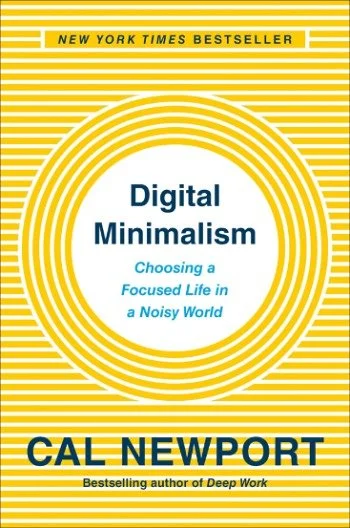
A solid book that basically expands and modernizes the philosophy of Henry David Thoreau described in Walden, when he noted that “the mass of men lead lives of quiet desperation”, alluding to how people filled their time with distractions, not even considering what was essential to them. But the less quoted text and one that’s more hopeful, Newport argues, can be found in the same book by Thoreau:
“They honestly think there is no choice left. But alert and healthy natures remember that the sun rose clear. It is never too late to give up our prejudices.”
Back then (the middle of the 19th century), the invention of the telegraph and the accelerated rhythm of the increasingly urbanized societies was a big deal that worried Thoreau. Now we have the internet and smartphones in our pockets which are undoubtedly even more potent in its scope and in its potential to capture our attention.
This book is Newport’s attempt to present a “fully-fledged philosophy of technology use”, rooted in our deep values, which will orient us in this frantic space of distraction and will serve as a guide to a more conscious life. Instead of fully abandoning social media — like the more pessimistic Jaron Lanier proposed —, Newport is arguing for a more deliberate use of technology and a stricter approach than what we’re currently employing. He is arguing for a form of digital minimalism.
Many of us want to be more conscious of how we use our time, and we’re not blind to the faults of new technologies and social media. However, the problem lies in the fact that we overestimate our will power to resist them and we underestimate their power to keep us hooked. Anxiety and depression is on the rise, and although it would be speculative to link it entirely to smartphones and social media, many researches indicate a correlation between the rise of social media on our smartphones (around 2011-2012) and the spike in mental diseases around the world. The main problem, argues Newport, is not that we are worried that these technologies are not useful, but that we lose the sense of autonomy — when we scroll down the Facebook feed we feel like we’re not the one in control, and given that these tools were engineered to be addictive, it’s not surprising that we’re feeling that way.
There’s a myth that technology is neutral, and although that’s true to some extent, it is naïve to think that all technology is neutral. Particularly, when it comes to big companies like Facebook and Google, which made their fortunes by capturing consumer’s attention and selling it to advertisers; their tech can’t be neutral by definition. The core idea of their business model is to convince you to spend as much time as possible on their platforms, it’s how they make their money, simple as that. If they started to minimize the distractions and have more respect for your attention they would lose money.
Now, that is nothing new, many of us have heard that, but how many of us have really considered that we are addicted to these platforms? To many of us addiction is a scary word, and usually refers to substance abuse, but if we take a look at its definition it becomes clear that it doesn’t stop at substance abuse:
“Addiction is a condition in which a person engages in use of a substance or in a behavior for which the rewarding effects provide a compelling incentive to repeatedly pursue the behavior despite detrimental consequences.” (p. 15).
It’s fair to point out that social media addiction has something which distinguishes it from the rest: it encourages behavioral addiction based on social urges that are innate in all human beings. It’s something that Adam Alter called in his 2017 book, Irresistible, “intermittent positive reinforcement and the drive for social approval.”
As Newport adds: “Our brains are highly susceptible to these forces. This matters because many of the apps and sites that keep people compulsively checking their smartphones and opening browser tabs often leverage these hooks to make themselves nearly impossible to resist.” (p. 17).
Since its birth, the internet has had some addictive nature to it, the iPod and then the iPhone had that as well to some extent, but everything changed drastically when Facebook introduced the “Like” icon in 2009. Why, you ask? Well…because of...pigeons:
“Scientists have known since Michael Zeiler’s famous pecking pigeon experiments from the 1970s that rewards delivered unpredictably are far more enticing than those delivered with a known pattern. Something about unpredictability releases more dopamine—a key neurotransmitter for regulating our sense of craving. The original Zeiler experiment had pigeons pecking a button that unpredictably released a food pellet.” (pp. 17-18).
The button that released a food pellet is basically the analogy of the “Like” icon that once pressed releases a dopamine hit in our brain. The pleasure is in the unpredictability: will you get likes at all when you post something? How many and from whom? This “gambling” aspect of it is what arguably made Facebook (and the other platforms that copied it) this influential. If you get likes, you get what a Facebook engineer called “bright-dings of pseudo-pleasure”, and if you don’t get any, or not as many as you’d like, you’ll feel bad. “Either way,” argues Newport, “the outcome is hard to predict, which, as the psychology of addiction teaches us, makes the whole activity of posting and checking maddeningly appealing." (p. 18).
The second addicting feature in “Likes” and “hearts” and other reaction emoticons is the social aspect of it, or more precisely, it’s the way it exploits our need for social approval.
As Newport points out:
“If lots of people click the little heart icon under your latest Instagram post, it feels like the tribe is showing you approval—which we’re adapted to strongly crave.* The other side of this evolutionary bargain, of course, is that a lack of positive feedback creates a sense of distress. This is serious business for the Paleolithic brain, and therefore it can develop an urgent need to continually monitor this 'vital' information.” (p. 21).
So keeping these two factors in our mind, what are Newport’s solutions?
In short, it’s Digital Minimalism, and this is how he defines it:
“A philosophy of technology use in which you focus your online time on a small number of carefully selected and optimized activities that strongly support things you value, and then happily miss out on everything else.” (p. 28).
In essence, he argues that instead of the default pro-tech approach, meaning that instead of accepting with open arms everything new in technology and potentially inviting more unnecessary distraction into our lives, a smarter approach would be to asses each addition based on your values and see if it connects with them. When a shiny new thing or new platform comes along you should ask yourself: “Is this useful for me? Do its benefits outweigh the cons? Is it worth my time? What will I lose if I don’t use it?”
This is a different approach than the default “hey, this looks cool, let me try It out”. It’s a form of techno-skepticism, which in healthy doses should be useful. This is where Newport crucially differs from Lanier — the author of 10 Arguments for Deleting Your Social Media Accounts Right Now —: the first argues that you should use a technology only if it has more pros than cons and if it connects with your values, the latter argues that the combo of social media + smartphone is “deadly” and should be avoided completely.
Newport looks for solutions within the current digital climate, while Lanier is a more stereotypical technophobe that is having nostalgic rants about the early internet. Personally, I identify more with Newport, as his solution is more pragmatic and would work for most of the population. Lanier’s solution is utopian in my eyes, or at least it’s reserved for a small cast of people which are addicted so badly that they literally need to quit “cold turkey”. Not to mention Lanier’s style of writing which is frankly annoying at best.
Newport’s Digital Minimalism rests on 3 main principles:
1) Clutter is costly – it means recognizing the danger in cluttering your time with too much digital stuff — apps, devices and so on which provide an overall negative effect on people’s ability to concentrate.
2) Optimization is important – you should decide if a particular digital addition into your life is connected to your values. It’s important to think how you’ll use a new technology.
3) Intentionality is satisfying – when you’re the one in control and you decide what new tech to use and how to use it, you gain more self-respect and you generally feel more satisfied. The specifics don’t matter so much as being intentional.
Personally, I think that the 3rd principle is the strongest and I can confirm in my own experience that it’s the one that will convert most people to being digital minimalists. This sense of power and calm you get once you’re more intentional over how you use your time and what things you should accept in your life are addicting, in a good way. If for anything, try being more intentional and see how you feel. Treat it like an experiment. Don’t just open Facebook and scroll down on your feed like a lab rat, but instead set a timer, or a certain limit to how much you’re going to scroll down. Say, 5 minutes, literally set a timer and then you’ll see how most of the time even 5 minutes seems like too much and you can see everything you really care about in under 3 minutes in your feed. Then you won’t feel like Zuckerberg is screwing you over and you’ll be the one who takes the wheel in your hands. I think simple and banal steps as these — setting a timer (or an app time limit in your phone settings) is severely underrated. It will make you realize that this fear of missing out is an illusion, you won’t miss anything important, and you’ll catch up in just a few minutes and then you’ll go on doing better things with your time.
The most powerful pull that social media has on us isn’t really the shiny app itself, but it’s the implied “social” things in it. Like Adam Alter writes: “We’re social beings who can’t ever completely ignore what other people think of us.” (p. 20).
A scientific study which is related to this is Lieberman’s “default network”, a state of your mind when you’re not doing anything. Turns out, your brain is never inactive, and even when you think you’re not doing anything, your brain is active within the “default network.” His research team “found that there’s a particular set of regions in the brain that consistently activate when you’re not attempting to do a cognitive task, and that just as consistently deactivate once you focus your attention on something specific. (…) our brains are hardly ever actually thinking about nothing. Even without a specific task, they tend to remain highly active, with thoughts and ideas flitting by in an ongoing noisy chatter. On further self-reflection, Lieberman realized that this background hum of activity tends to focus on a small number of targets: thoughts about ‘other people, yourself, or both.’ The default network, in other words, seems to be connected to social cognition." (pp. 132-133).
Now we have a clearer picture as to why we care so much about what’s happening on social media — especially when we’re bored —, it’s because of the default network which is connected to social cognition. Digital marketers and engineers know this and they exploit this feature of our brain to its full extent. But I think we can counter this individually by at least being aware of it. That’s the first step anyways.
There’s also some research which suggests that lack of social connection can cause physical pain, and that’s not surprising considering we’ve evolved over millions for years within tribes and in close proximity to other people — in other words, our life depended on it and natural selection favored people who where more social. Thus we feel physical pain if we lack connection, and digital connection is not the same as face-to-face, it’s an imitation of it (and I’m sure a lot of us felt that during the global pandemic). Social media is an alternative to traditional communication, not a replacement.
One of my favorite chapters in the book is called “The Value of Solitude”. The gist of it is this: We all need healthy does of solitude in order to understand ourselves and how we relate to others. If we’re constantly distracted by technology or people, we paradoxically distance ourselves from them due to exhaustion.
...
OK then, what should we do, what is Newport’s advice?
Walk more, like Nietzsche or Abraham Lincoln used to do, and carry a small notebook in your pocket to write down your thoughts. This is what Newport calls “productive solitude”, and I agree with him — walking is underrated. Newport also recommends taking Aristotle’s advice in Nicomachean Ethics:
“a life filled with deep thinking is happy because contemplation is an ‘activity that is appreciated for its own sake . . . nothing is gained from it except the act of contemplation.’” (p. 165). In other words, a life well lived requires activities that serve no other purpose than the satisfaction that the activity itself generates. It’s what Newport calls “high-quality leisures”.
Other advice he gives is not clicking “Like” on social media — ever — and that seems amusing and frankly way too dramatic to me, but hey if it’s your thing, try it out, maybe he’s right. He also recommends doing something physical in the world, joining a group of people who have the same interests, or deleting social media from your phone (and only accessing it when you sit down at a computer…based on a set schedule, yeah).
Basically it’s the old-fashioned dad advice sprinkled with some modern context. To some his advice may seem too extreme, or restraining, and I’m not a fan of all of it, but I agree with the overall sentiment: be more intentional in your use of digital media and try to be more present in the physical world.
Rating: 4/5