F. Scott Fitzgerald: The Great Gatsby - book review
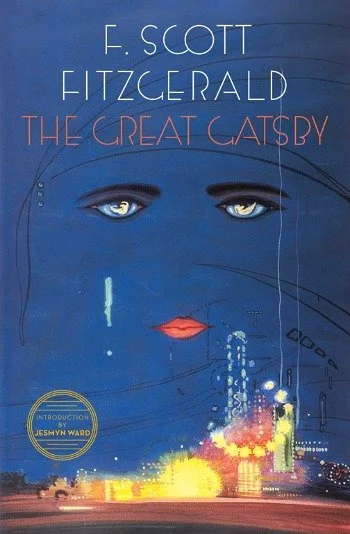
It’s hard to explain what exactly makes this novel a great one, I wouldn’t say it’s the plot or the originality of it; in fact, it’s the same old story about longing for a past love, a wish to relive what was meant to be temporary, the obsession with controlling what you can’t, fantasizing about someone to the point of exaggerating their good qualities, being pulled in by people’s perception of you and thus creating a separate persona, one that ends up serving others instead of your own self. All these descriptions are portrayed and expressed most profoundly — but not solely — through the main character, Jay Gatsby.
So here I am sitting at my desk and thinking how to describe that which is to be mostly felt. Yes, it is a novel that you feel, taste and perceive, rather than rationalize or categorize. And then it clicked. I realized I was enamored by how Fitzgerald wrote, how he turned a simple scene into something so aesthetically pleasing that it becomes impossible not to like. Every setting leaves you with a pleasant aftertaste, like a well-made wine, and with time, when you relive some scenes in your head, it emerges in a slightly different way, you notice some parts you’ve missed the first time, but the magic still persists. That all sounds, of course, quite esoteric and hard to grasp, but it became clearer to me why I liked this novel once one of my friends (Eric) noted that the descriptions, the scenes, the way in which Fitzgerald writes is part of the plot, it’s not separate, no, it plays a central part in it, because the descriptions leave you with a perception, with a sense of wonder as if you’d just seen a magic trick. In other words, the aesthetic descriptions aren’t the cherry on the top, they are the layers of the cake itself.
And then I understood. Then every sentence that I’ve highlighted while reading explained itself to me, it became clear why I liked it so much. It’s in the how, not necessarily in the why or the what. Because if I’d tell you the synopsis of this novel it will surely seem generic, but that would be missing the whole point. So I won’t waste time in explaining the plot or spoiling it; instead, I will quote the scenes I liked the most, and you’ll decide if I’m crazy or if Fitzgerald really is a great writer.
The novel begins with the end, the narrator being one of characters who lived through what happened with Gatsby and the people close to him, so we are left with a prelude that also anticipates (or imprints?) future impressions. Right from the start, Fitzgerald creates a certain mysticism about Gatsby’s character:
“When I came back from the East last autumn I felt I wanted the world to be in uniform and at a sort of moral attention forever; I wanted no more riotous excursions with privileged glimpses into the human heart. Only Gatsby, the man who gives his name to this book, was exempt from my reaction — Gatsby, who represented everything for which I have an unaffected scorn. If personality is an unbroken series of successful gestures, then there was something gorgeous about him, some heightened sensitivity to the promises of life, as if he were related to one of those intricate machines that register earthquakes ten thousand miles away. This responsiveness had nothing to do with that flabby impressionability which is dignified under the name of the ‘creative temperament’ — it was an extraordinary gift for hope, a romantic readiness such as I have never found in any other person and which it is not likely I shall ever find again. No — Gatsby turned out all right at the end; it is what preyed on Gatsby, what foul dust floated in the wake of his dreams that temporarily closed out my interest in the abortive sorrows and short-winded elations of men.” (p. 2).
Further in the novel Nick Carraway (the narrator) describes his first impressions of Gatsby. And in these impressions you get a sense of liking a person who imprints on you what you want to see, rather than what is:
“He [Gatsby] smiled understandingly — much more than understandingly, it was one of those rare smiles with a quality of eternal reassurance in it, that you may come across four or five times in life. It faced — or seemed to face — the whole external world for an instant, and then concentrated on you with an irresistible prejudice in your favor. It understood you just so far as you wanted to be understood, believed in you as you would like to believe in yourself, and assured you that it had precisely the impression of you that, at your best, you hoped to convey. Precisely at that point it vanished — and I was looking at an elegant young rough-neck, a year or two over thirty, whose elaborate formality of speech just missed being absurd, some time before he introduced himself I’d got a strong impression that he was picking his words with care.” (p. 36).
The short, but telling observation (in the way that it explains the upside-down world of the Jazz Age) of Jordan Baker, one of the ladies at a party which Gatsby organized at his house:
“Anyhow, he gives large parties, and I like large parties. They’re so intimate. At small parties there isn’t any privacy.” (p. 37).
The moment when Gatsby realizes that his fantasy, turned into reality, kills something impalpable in his life, erasing the magic. It’s as if some things are better left as they are, simple fantasies:
“‘If it wasn’t for the mist we could see your home across the bay,’ said Gatsby. ‘You always have a green light that burns all night at the end of your dock.’
Daisy put her arm through his abruptly, but he seemed absorbed in what he had just said. Possibly it had occurred to him that the colossal significance of that light had now vanished forever. Compared to the great distance that had separated him from Daisy it had seemed very near to her, almost touching her. It had seemed as close as a star to the moon. Now it was again a green light on a dock. His count of enchanted objects had diminished by one.” (p. 70).
One of my favorite parts are the gorgeous paragraphs in chapter 6 (both in psychological insight and aesthetics) in which the narrator describes Gatsby’s background, or at least who he conceived himself to be when he was young:
“His parents were shiftless and unsuccessful farm people — his imagination had never really accepted them as his parents at all. The truth was that Jay Gatsby of West Egg, Long Island, sprang from his Platonic conception of himself. He was a son of God — a phrase which, if it means anything, means just that — and he must be about His Father’s business, the service of a vast, vulgar, and meretricious beauty. So he invented just the sort of Jay Gatsby that a seventeen-year-old boy would be likely to invent, and to this conception he was faithful to the end.
For over a year he had been beating his way along the south shore of Lake Superior as a clam-digger and a salmon-fisher or in any other capacity that brought him food and bed. His brown, hardening body lived naturally through the half-fierce, half-lazy work of the bracing days. He knew women early, and since they spoiled him he became contemptuous of them, young virgins because they were ignorant, of the others because they were hysterical about things which in his overwhelming self-absorption he took for granted.
But his heart was in a constant, turbulent riot. The most grotesque and fantastic conceits haunted him in his bed at night. A universe of ineffable gaudiness spun itself out in his brain while the clock ticked on the wash-stand and the moon soaked with wet light his tangled clothes upon the floor. Each night he added to the pattern of fancies until drowsiness closed down upon some vivid scene with an oblivious embrace. For a while these reveries provided an outlet for his imagination; they were a satisfactory hint of the unreality of reality, a promise that the rock of the world was founded securely on a fairy’s wing.” (p. 75).
More can be said about this novel, I’m sure. And I have a stalking feeling that after writing this review I’ll remember something I’ve missed, but so be it. Maybe some things are truly better left unsaid.
"So we beat on, boats against the current, borne back ceaselessly into the past." (p. 140).
Rating: 5/5