H.P. Lovecraft: From Beyond - short story review
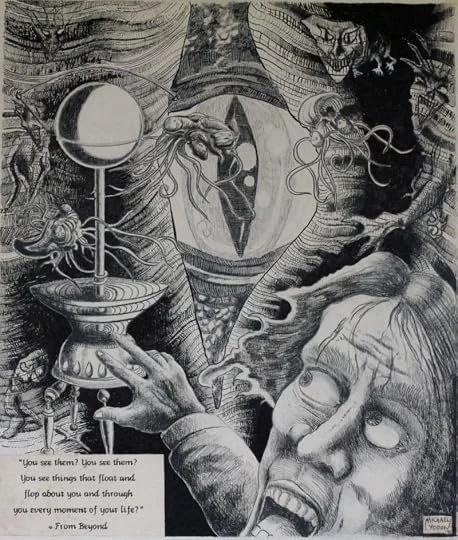
"That Crawford Tillinghast should ever have studied science and philosophy was a mistake. These things should be left to the frigid and impersonal investigator, for they offer two equally tragic alternatives to the man of feeling and action; despair if he fail in his quest, and terrors unutterable and unimaginable if he succeed. Thillingast had once been the prey of failure, solitary and melancholy; but now I knew, with nauseating fears of my own, that he was the prey of success." (The Complete Fiction of H.P. Lovecraft, p. 131)
When you were a kid, were you afraid of darkness? Did you ever think that there could be someone in that darkness, someone that breathes on your shoulder without you feeling a thing? I sure did. Lovecraft captured this creepy feeling in this short story about a scientist (Thillingast) that lost his mind after he found "a way to break down the barriers" between this world and "the beyond" by building a machine which lets you see ultra-violet waves and other weird shit (at times it seems a description of a LSD trip gone bad). Hmm, now that I think about it, it reminds me of Stranger Things (a show on Netflix), which may have been inspired by Lovecraft. Also, apparently a (B-rated) sci-fi movie (with the same name) was made in the 80's based on this story.
This story is fantasy horror, but it has bits of what I call "speculative truth" that makes it so much creepier. If it was all just fantasy it wouldn't have the same effect, and that's why I think Lovecraft is in a league of his own. He's able to transport you in a fantasy world which could hypothetically—if you suspend your scientific mind for a moment—exist.
Here's Thillingast's ramblings on the nature of our limited senses (on which even the famous philosopher Descartes once spoke about):
"What do we know ... of the world and the universe about us? Our means of receiving impressions are absurdly few, and our notions of surrounding objects infinitely narrow. We see things only as we are constructed to see them, and can gain no idea of their absolute nature. With five feeble senses we pretend to comprehend the boundlessly complex cosmos, yet other beings with a wider, stronger, or different range of senses might not only see very differently the things we see, but might see and study whole worlds of matter, energy, and life which we lie close at hand yet can never be detected with the senses we have." (p. 132)
I particularly like this simple sentence that describes "the beyond" (how can this not give you the creeps?):
"We shall see that at which dogs howl in the dark, and that at which cats prick up their ears after midnight." (p. 132)
Rating: 4/5