Jorge Luis Borges: Tlön, Uqbar, Orbis Tertius - short story review
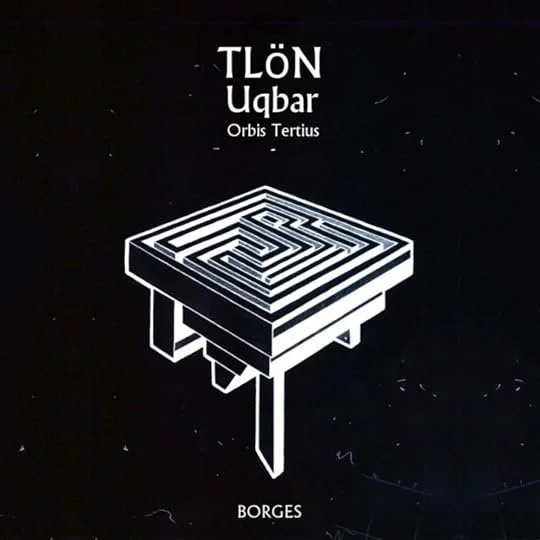
A cryptic short story in which Borges imagines a mysterious and fictional planet with different nations in which “Their language, with its derivatives—religion, literature, and metaphysics—presupposes idealism. For them, the world is not a concurrence of objects in space, but a heterogeneous series of independent acts. There are no nouns in the hypothetical Ursprache of Tlön, which is the source of the living language and the dialects; there are impersonal verbs qualified by monosyllabic suffixes or prefixes which have the force of adverbs. For example, there is no word corresponding to the noun moon, but there is a verb to moon or to moondle.” (p. 23)
It is a bizzare idea, but it is surprisingly well-developed — even if the story is short, Borges describes Tlön with enough detail for the reader to imagine a culture of beings that are truly alien to us and our way of living, yet have their own set of rules they follow. Also, the Wikipedia page on this story made a fascinating point on the fact that Western philosophy wouldn’t be possible without nouns:
“In a world where there are no nouns—or where nouns are composites of other parts of speech, created and discarded according to a whim—and no things, most of Western philosophy becomes impossible.” (Wikipedia)
So in a way Borges seems to be trolling us, mortals. What a mad lad, huh.
The planet of Tlön, albeit having different nations, is a monoculture, an extremely-idealistic one, in which its people “conceive of the Universe as a series of mental proccesses whose unfolding is to be understood only as a time sequence.”(p. 24). Or in other words, they view psychology as the main scientific discipline, and all the others are subordinate to it:
“To put it another way—they do not conceive of the spatial as everlasting in time. The perception of a cloud of smoke on the horizon and, later, of the countryside on fire and, later, of a half-extinguished cigar which caused the conflagration would be considered an example of the association of ideas. This monism, or extreme idealism, completely invalidates science. To explain or to judge an event is to identify or unite it with another one. In Tlön, such connection is a later stage in the mind of the observer, which can in no way affect or illuminate the earlier stage. Each state of mind is irreducible. The mere act of giving it a name, that is of classifying it, implies a falsification of it.” (pp. 24-25)
In a way, it may be implied that it is a culture where silence has real value? I’m not sure, but it’s intriguing. On that planet silence is good in itself, you don’t need to name and classify everything, and in trying to name it you may loose its essence. Now that I think of it, it seems very Oriental, something to do with Taoism, maybe?
“The metaphysicians of Tlön are not looking for truth, nor even for an approximation of it; they are after a kind of amazement.” (p. 25)
Also, this monotheism reflects on the way they deal with book authors and other artists, they have a world where the concept of plagiarism doesn’t exist because “all authors are one” — this one is probably the hardest to imagine, and seems especially strange:
“In literary matters too, the dominant notion is that everything is the work of one single author. Books are rarely signed. The concept of plagiarism does not exist; it has been established that all books are the work of one single writer, who is timeless and anonymous. […] A book which does not include its opposite, or “counter-book,” is considered incomplete.” (p. 28).
It seems to suggest a collective consciousness to which everyone contributes in his or her own way. Is this collective consciousness God? Is it a despotic tyranny? something else? Is it gibberish? Is it satire of Orientalism or of pseudo-psychology? Maybe. Maybe not. Borges lets you decide, he’s clearly not one to give you spoon-fed conclusions.
I particularly like his idea of a “hrönir” – a duplicate of something that maybe have been made from duplicates themselves and so on. They way in which Borges describes it seems to imply that he’s satirizing the notion of “original creations” in our human culture — we all plagiarize from someone who plagiarized from someone else (ad infinitum), it’s inevitable. But at the same time, it may be interpreted as a compliment for our ingenuity — plagiarism and storing information allowed us to build civilizations which surpassed a single consciousness —in a way, our libraries, sciences, discoveries, languages are all a work of a “collective consciousness” copying, making new breakthroughs, and passing over information. This idealistic planet of Tlön is not completely imaginary after all, as it has similarities with our own:
“One curious fact: the hrönir of the second and third degree—that is, the hrönir derived from another hrön, and the hrönir derived from the hrön of a hrön—exaggerate the flaws of the original; those of the fifth degree are almost uniform; those of the ninth can be confused with those of the second; and those of the eleventh degree have a purity of form which the originals do not possess. The process is a recurrent one; a hrön of the twelfth degree begins to deteriorate in quality. Stranger and more perfect than any hrön is sometimes the ur, which is a thing produced by suggestion, an object brought into being by hope. Things duplicate themselves in Tlön. They tend at the same time to efface themselves, to lose their detail when people forget them. The classic example is that of a stone threshold which lasted as long as it was visited by a beggar, and which faded from sight on his death. Occasionally, a few birds, a horse perhaps, have saved the ruins of an amphitheater.” (p. 30)
And yet here I am wondering … if what I said thus far is completely wrong, and if Borges wrote this convoluted little story just to laugh at us poor readers; and If he did, I wouldn’t be too upset as it’s a masterful troll.
Rating: 3.5/5