Sam Harris: Free Will - book review
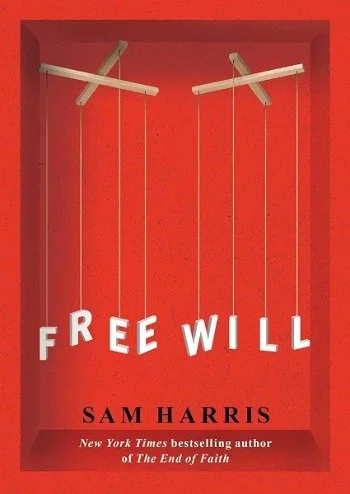
A rather disappointing and shallow look at the illusion of free will. As others have mentioned before me, this should've been a blog post or two, not a book. I get the arguments, and I agree with some of them and disagree with others, but that's not the point. I'm disappointed in how brief and unphilosophical his ruminations were on various implications of us realizing that free will is an illusion (which it most probably is). The implications are so vast that he should've spent way more time discussing its influence on the justice system, our individual and our group psychologies, parenting, etc.
Just as he warmed me up he decides to end the book because he thinks he "made his point" and "can't think of anything else to say on the subject". I find it funny because the so-called philosophers usually have a hard time shutting up and making their point brief, but here's Sam on the other extreme throwing a few crumbles and thinking they're profound enough to sustain his thesis—and the problem isn't even proving the thesis (the illusion of free will is now widely accepted in scientific fields), rather it's providing good arguments on how realizing that free will is an illusion will improve our society.
Here's the main thesis of this book:
"Free will is an illusion. Our wills are simply not of our own making. Thoughts and intentions emerge from background causes of which we are unaware and over which we exert no conscious control." (p. 5)
And to expand on this idea:
“The intention to do one thing and not another does not originate in consciousness—rather, it appears in consciousness, as does any thought or impulse that might oppose it.” (p. 8)
So far so good. The thesis is good enough on its own, and there’s neurological data to back it up, like when “The experimenters found two brain regions that contained information about which button subjects would press a full 7 to 10 seconds before the decision was consciously made.” (p. 8)
In other words, we appear like we have complete freedom to do whatever we please, but in reality our brain has already determined what we’ll do. “You then become conscious of this ‘decision’ and believe that you are in the process of making it.”
Sam also makes a distinction between voluntary and involuntary actions (and yes, there’s no free will in either of them):
“There is a distinction between voluntary and involuntary actions, of course, but it does nothing to support the common idea of free will (nor does it depend upon it). A voluntary action is accompanied by the felt intention to carry it out, whereas an involuntary action isn’t. Needless to say, this difference is reflected at the level of the brain. And what a person consciously intends to do says a lot about him.” (p. 12)
In other words, it makes sense to treat a murderer differently from someone who killed a person by accident, but the problem is that we don’t know where intentions come from — they are, still, mostly a mystery.
“Our sense of free will results from a failure to appreciate this: We do not know what we intend to do until the intention itself arises. To understand this is to realize that we are not the authors of our thoughts and actions in the way that people generally suppose.” (p. 13)
He then goes on explaining 3 different philosophical approaches to the problem of free will:
1. Determinism - Determinists believe that free will is an illusion because our behavior is fully determined by background causes. (Harris is a determinist)
2. Libertarianism – “Libertarians imagine that human agency must magically rise above the plane of physical causation. Libertarians sometimes invoke a metaphysical entity, such as a soul, as the vehicle for our freely acting wills.” (pp. 15-16)
3. Compatibilism – “Compatibilists, however, claim that determinists and libertarians are both confused and that free will is compatible with the truth of determinism.” (p. 16)
Harris then goes on explaining the predominant compatibilist view, which “endorses free will in a deterministic universe”. He mainly “attacks” his friend Daniel Dennett, who is a compatibilist. Harris thinks the compatibilist approach to free will is similar to theology, which is a fair enough and needs to be pointed out, they do seem to believe that even if we aren’t the ones creating our decisions, that “thing” (soul?) that creates our decisions without us knowing is still us, we just don’t perceive it as such.
Harris mocks this view by making the analogy with our body processes: our heart may be beating, our blood may be pumping, food may be digested, and it’s part of us, but we are not consciously doing that: we don’t decide how our liver acts and how many (or which) hormones are released in stress situations.
To me, it seems like a lazy (and straw-man type of) criticism, but I still agree with Sam on this one, and I particularly like the analogy he makes with stardust:
“The psychological truth is that people feel identical to a certain channel of information in their conscious minds. Dennett is simply asserting that we are more than this—we are coterminous with everything that goes on inside our bodies, whether we are conscious of it or not. This is like saying we are made of stardust—which we are. But we don’t feel like stardust. And the knowledge that we are stardust is not driving our moral intuitions or our system of criminal justice.” (pp. 22-23)
At the same time, what I see here is a clash of different notions of “free” — determinists (like Sam Harris) think of the word “free” in an absolute, empirical and almost utopical sense, while compatibilists (like Dennett) think of the word “free” in a more abstract way — “A puppet is free as long as he loves his strings.” (p. 20) This is a definition problem that isn’t really addressed and that is one of my disappointments about this book: Harris assumes we all have the same definition of “freedom” like he does, and that comes up as a bit arrogant, or just dismissive (without explaining why).
Harris does give credit to Dennett for pointing out the difference between determinism and fatalism (which is an important distinction):
“As Dan Dennett and many others have pointed out, people generally confuse determinism with fatalism. This gives rise to questions like ‘If everything is determined, why should I do anything? Why not just sit back and see what happens?’ This is pure confusion. To sit back and see what happens is itself a choice that will produce its own consequences. It is also extremely difficult to do: Just try staying in bed all day waiting for something to happen; you will find yourself assailed by the impulse to get up and do something, which will require increasingly heroic efforts to resist.” (pp. 33-34)
Harris assumes that “becoming sensitive to the background causes of one’s thoughts and feelings can—paradoxically—allow for greater creative control over one’s life.”, which is, frankly, a very subjective statement. But then again, he said “it can”, not “it will”, so he’s not as sure about the effects this realization will have on our minds — and this is precisely the thing that I find the most intriguing, and Harris (almost) completely ignores it. That’s too bad, because if he spent some time by actually philosophizing more, he might’ve developed better and more nuanced arguments which would greatly improve his point.
Harris brings a hypothetical situation where “a man who had been raised by wonderful parents and never abused intentionally shot and killed a young woman he had never met ‘just for the fun of it.” An MRI of the man’s brain revealed a tumor the size of a golf ball in his medial prefrontal cortex (a region responsible for the control of emotion and behavioral impulses).” (p. 50)
He argues that “if we couldn’t cure his condition, we would still need to lock him up to prevent him from committing further crimes, but we would not hate him or condemn him as evil.” (p. 54) which is a very idealistic view of human nature. The fact that I and Harris may agree that he wasn’t “evil” and just mentally ill doesn’t negate the more common feeling of hate people will feel anyways, because that’s what we are and that’s how we evolved as a species. I don’t know what model of a human being Harris has in his mind, but if he imagines that the average human being has a degree in philosophy and a PhD in neuroscience, drinks expensive coffee every day and has time to read multiple books a week and host a podcast, then he needs a reality check.
“No human being is responsible for his genes or his upbringing, yet we have every reason to believe that these factors determine his character. Our system of justice should reflect an understanding that any of us could have been dealt a very different hand in life. In fact, it seems immoral not to recognize just how much luck is involved in morality itself.” (p. 54)
I agree, Sam. But this seems to me almost impossible to implement when most justice systems are based on the existence of free will.
“The urge for retribution depends upon our not seeing the underlying causes of human behavior.” (p. 55)
True, but it also depends on the realities of human evolution — we are mostly emotional creatures. Thankfully, Harris does address this issue in more detail, bringing the example of an article written by Jared Diamond in The New Yorker in which “He compares the experiences of two people: his friend Daniel, a New Guinea highlander who avenged the death of a paternal uncle; and his late father-in-law, who had the opportunity to kill the man who murdered his entire family during the Holocaust but opted instead to turn him over to the police. (After spending only a year in jail, the killer was released.) The consequences of taking revenge in the first case and for-going it in the second could not have been starker. While there is much to be said against the vendetta culture of the New Guinea highlands, Daniel’s revenge brought him exquisite relief. Whereas Diamond’s father-in-law spent the last 60 years of his life ‘tormented by regret and guilt.’” (p. 57)
Thus vengeance is part of us, we can’t escape this reality, we evolved like that, We killed members of other tribes because they killed members of our tribe, and that’s how we survived. So “Clearly, vengeance answers to a powerful psychological need in many of us.” (p. 57)
“It may be true that strict punishment—rather than mere containment or rehabilitation—is necessary to prevent certain crimes. But punishing people purely for pragmatic reasons would be very different from the approach that we currently take.” (p. 59)
His “pragmatic reasons” are “Where people can change, we can demand that they do so. Where change is impossible, or unresponsive to demands, we can chart some other course. In improving ourselves and society, we are working directly with the forces of nature, for there is nothing but nature itself to work with." (p. 62)
First, who the fuck is “we” and who decides this? Seems like an utilitarian utopia. Also, “we are working directly with the forces of nature” — how exactly do you plan to do that? Change our human nature? Our biology? Yeah, good luck with that, Sam.
“How much credit does a person deserve for not being lazy? None at all. Laziness, like diligence, is a neurological condition.” (p. 62)
I can see how believing this is a very bad idea though. How are you going to parent your kid? “Oh don’t worry for being lazy, it’s your neurological condition”, sure, can’t wait to see that working out.
This book is a decent introduction to the free will conundrum, I guess, but if you want a thorough philosophical and neurological analysis, look elsewhere.
I don’t see the problem of free will solved once and for all in near future. Until we understand what consciousness actually is (which could never happen), we won’t get any closer to explaining the mysterious origins of our thoughts.
“You are not in control of your mind—because you, as a conscious agent, are only part of your mind, living at the mercy of other parts. You can do what you decide to do—but you cannot decide what you will decide to do.” (pp. 37-38).
Rating: 2.5/5