Karel Čapek: R.U.R. (Rossum's Universal Robots) - book review
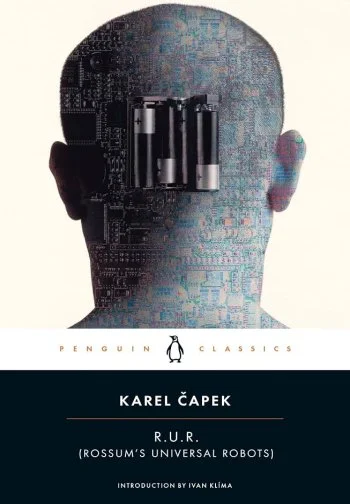
The drama that started it all, at least when it comes to “robots”—this theatre piece with three acts and a prologue popularized the term “robot” in sci-fi literature. It was written by one of the greatest Czech writers you probably never heard of—Karel Čapek. The story has become almost a cliché: A visionary man wants to “scientifically dethrone God, and prove that God is unnecessary (p. 7)”, so he invents robots (resembling men) and builds them to serve our needs—mostly manual labor and factory work, but then it extends to them being personal assistants and doing any routine tasks that people don’t want to do. At first, robots are pretty basic, they’re not conscious and just serve us, but then shit starts to happen. Sound familiar?
Some humans oppose the “oppression”, moralizing the issue and arguing that robots deserve to have rights; some think robots are a means to an end—they don’t feel anything, can work endlessly without complaining, are not conscious and thus are not able to suffer; some want all men to become “masters” and to get rid of the social hierarchy; others think that life loses meaning if people don’t work, blaming the utopian ideal of endless leisure. Then some human scientist decides to “play God” by improving the robots and making them more intelligent and “more human”. Robots become conscious, realize they’re smarter than humans, form a rebellion, and wipe the humans out. The end. (the actual end is a bit more nuanced, but I won’t spoil it).
I Robot? Terminator? Matrix? Westworld? You name it. All these were (directly or loosely) inspired by Capek’s work. That’s why it’s fascinating to read (or attend a play of) R.U.R.—it’s original and timeless. It’s deceivingly simple and succinct, yet it’s profoundly archetypal—you can find all the different philosophies on the “robot issue” portrayed via the characters of this play.
Having been written in 1920, the setting is clear: it’s the interwar period, there’s lots of factories courtesy of the industrial revolution (which started a century ago) and Europe needs to be rebuilt after the war. Hence the relentless race for more efficiency was the uber-ideology of the day. The main fear and worry portrayed in literature and in society at the time was that it dehumanized people, making them means to an end, the end being open-ended: more profit, more production, more workers, more manual labor, more profit, etc.
The word “robot” wasn’t actually invented by Čapek, it comes from the slavic “robota” (pабота; work; forced laborer). It’s a term which classified those peasants obligated to compulsory service under the feudal system—a system which was eventually abolished by the “Robot Patent” issued by Joseph II, Holy Roman Emperor, in the 1700s, which abolished compulsory labor (robot) of working peasants; then it was restored again by Leopold II; then came the European Revolutions of 1848 which broke the last legal tie which held the peasants to the land, and was seen as a great victory by the peasants. So the story of robots’ rebellion is not accidental, it has real historical ties depicting the revolts of working peasants under feudal systems.
Still, the modern term of “robot” as a “human automata” is first introduced in R.U.R.—and I should also note that Karel Čapek credited his brother Joseph for inventing this term.
In the first half of the 20th century—when R.U.R. was written—there was an urgent need for more productivity, more need for work, more need for “robota”—for robots, you see. Taking this into context, it becomes clear what was Capek’s intention: R.U.R. is a dystopia and a satire, it seeks to bring to light the absurdity of our desires, our conflicting idealisms, our own hypocrisy and vanity. It seeks to provoke, not patronizingly, but empathetically. This, in my opinion, is where this story excels. It portrays characters with opposite philosophies and it makes us understand each one of them. No one is “totally right”, and no one is “totally wrong”. In other words: it’s complicated.
Here’s Čapek himself describing this very same ambiguity:
“And now for my second idea, the comedy about truth. General director Domin tries to prove in the play that technical developments liberate man from heavy physical labor, and he is right. Alquist, the Tolstoyan architect, believes on the contrary that technical developments demoralize man, and I think that he is right, too. Busman thinks that only industrialism is capable of meeting modern needs; he is right. Helena instinctively fears all this human machinery, and she is quite right. And finally, the Robots themselves revolt against all these idealisms, and it seems that they are right as well.
We don’t need to look for names for all these various antithetical idealisms. What I want to stress is that no matter whether these people are conservatives or socialists, yellow or red, all of them are right in a simple moral sense of the word. All of them have the most serious of motives, material and spiritual, for their beliefs, and according to their nature look for the greatest happiness for the greatest number of their fellows. I ask myself: isn’t it possible to see in the contemporary social conflicts taking place in the world an analogous struggle between two, three or five equally serious and noble idealisms? I believe that it is possible. The most dramatic element in modern civilization is the fact that one human truth stands against a truth no less human, one ideal against another ideal, one positive value against a value no less positive, and that the conflict does not represent, as we are often told, a struggle between a noble truth and vile, selfish evil.”
Rating: 4/5