Carl Jung: The Undiscovered Self - book review
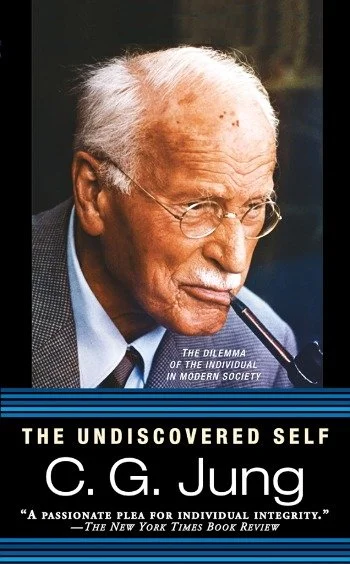
A good introduction to the thoughts of one of the deepest thinkers of the 20th century. In this small book (written in 1957, late in his career) Jung makes a plea for the individual in a society that is leaning more and more towards „mass thinking”. It’s a book that makes more sense in the context of post-World War 2 morality, as his criticism for Marxist and Communist thinking are evident, as well as the warning against a „split consciousness”—a term he coined for the rupture between faith and knowledge and which he considers „a mental disorder of our day”.
He claims that ignoring our „shadow”—which is an unconscious aspect of the personality which the conscious ego does not identify in itself; the unknown side, is making us naive and irresponsible. (in the sense that ignoring the capacity for evil within ourselves is making us blind towards idealisms and utopic ideas; thus making us more vulnerable against „mass States” and dictators)
„To be ideal is impossible, and remains therefore an unfulfilled postulate. Since we usually have keen noses in this respect, most of the idealisms that are preached and paraded before us sound rather hollow and become acceptable only when their opposite is openly admitted to. Without this counter-weight the ideal goes beyond our human capacity, becomes incredible because of its humorlessness and degenerates into bluff, albeit a well-meant one. Bluff is an illegitimate way of overpowering and suppressing people and leads to no good.” (p. 101)
Jung blames „mass State” regimes for being incapable of self-criticism, an activity which, ironically, is being asked of us, individuals. Jung says that Marxist countries aim for the „isolation of the individual”—a claim which seems to refer to the specific Communist regimes in his time, however, since I personally noticed a resurgence of Marxist ideologies among University students in the West (and in my case, in Canada), it is alarming and, in my opinion, still relevant.
„Funnily enough, ’self-criticism’ is an idea much in vogue in Marxist countries, but there it is subordinate to ideological considerations and must serve the State, and not truth and justice in men’s dealings with one another. The mass State has no intention of promoting mutual understanding and the relationship of man to man; it strives, rather, for atomization, for the psychic isolation of the individual. The more unrelated individuals are, the more consolidated the State becomes, and vice versa.” (p. 100)
In the beginning of the book, Jung argues that our definition of self-knowledge is uninspired, and given that we ignore the importance of the unconscious, quite naive:
„Most people confuse ’self-knowledge’ with knowledge of their conscious ego personalities. Anyone who has ego-consciousness at all takes it for granted that he knows himself. But the ego knows only its own contents, not the unconscious and its contents. People measure their self-knowledge by what the average person in their social environment knows of himself, but not by the real psychic facts which are for the most part hidden from them. In this respect the psyche behaves like the body with its physiological and anatomical structure, of which the average person knows very little too. Although he lives in it and with it, most of it is totally unknown to the layman, and special scientific knowledge is needed to aquaint consciousness with what is not known, which also exists.” (p. 6)
He also brings our attention to the fact that statistics don’t always help us with having more self-knowledge:
„Since self-knowledge is a matter of getting to know the individual facts, theories help very little in this respect. For the more a theory lays claim to universal validity, the less capable it is of doing justice to the individual facts. Any theory based on experience is necessarily statistical; that is to say, it formulates an ideal average which abolishes all exceptions at either end of the scale and replaces them by an abstract mean. This mean is quite valid, though it need not necessarily occur in reality.” (p. 7)
„There is and can be no self-knowledge based on theoretical assumptions, for the object of self-knowledge is an individual—a relative exception and an irregular phenomenon.” (p. 8)
Still, he is quick to admit that we need statistics:
„At the same time man, as a member of a species, can and must be described as a statistical unit; otherwise nothing general could be said about him. (p. 8)
A central idea in Jung’s thought is the distinction between understanding and knowledge:
„If I want to understand an individual human being, I must lay aside all scientific knowledge of the average man and discard all theories in order to adopt a completely new and unprejudiced attitude. I can only approach the task of understanding with a free and open mind, whereas knowledge of man, or insight into human character, presupposes all sorts of knowledge about mankind in general.” (p. 9)
I have to disagree on this one, why does understanding a man exclude knowing a man? Why are they mutually exclusive? I’d argue that you can’t understand a man with „an open mind” without having some knowledge about him—some scientific facts about him beforehand.
„I must lay aside all scientific knowledge of the average man..in order to adopt a completely new and unprejudiced attitude.”
Really, Jung? All scientific knowledge? This passage seems strangely absolutist, especially for a thinker like Jung. Also, how can you be „unprejudiced”? If you didn’t ignore the importance of „knowledge” of man you’d admit that we are all to some extent prejudiced—it’s impossible to have zero prejudice, we’re not built like that.
Jung continues,
„Judged scientifically, the individual is nothing but a unit which repeats itself ad infinitum and could just as well be designated with a letter of the alphabet. For understanding, on the other hand, it is just the unique individual human being who, when stripped of all those conformities and regularities so dear to the hear of the scientist, is the supreme and only real object of investigation. The doctor, above all, should be aware of this contradiction. On the other hand, he is equipped with the statistical truths of his scientific training, and on the other, he is faced with the task of treating a sick person who, especially in the case of psychic suffering, requires individual understanding.”
OK Jung, I get it, the patient requires an individual understanding, no one denies that. However, how is scientific training impeding a doctor to „individually understand” a patient? Again, why are they mutually exclusive? Why do you ignore the fact that your „individual understanding” is heavily influenced by your scientific knowledge of the patient, and that it’s actually more of a good thing than bad? You can’t cure someone solely on empathy and understanding. This type of thinking is, frankly, dogmatic.
Unfortunately, parts like this make me understand why a lot of „new age” and „open-minded” people took Jung close to heart and even idolized him in the 60’s and the following decades. Even though he’s one of my favorite thinkers, I can’t deny that he attracts some „voodoo sh*t” people that deny all science and are delusional. It’s unfortunate, because for the most part, Jung is more nuanced in his views. Ironically, at times this book seems like a propaganda for the individual rather than a balanced assessment of our „cultural malaise”.
Leaving aside his strange view on science, he does bring some good points on how the abstract idea of „the State” influences individuals and their way of living, making them more passive:
„...the abstract idea of the State as the principle of political reality. The moral responsibility of the individual is then inevitably replaced by the policy of the State. Instead of moral and mental differentiation of the individual, you have public welfare and the raising of the living standard. The goal and meaning of individual life (which is the only real life) no longer lie in individual development but in the policy of the State, which is trust upon the individual from outside and consists in the execution of an abstract idea which ultimately tends to attract all life to itself. The individual is increasingly deprived of the moral decision as to how he should live his own life, and instead is ruled, fed, clothed and educated as a social unit...” (p. 12)
This one seems more plausible, although again, „the individual life is the only real life” seems a bit far-fetched and one-sided. Many people would disagree, and I’m somewhere in the middle. I do agree that the individual life is the most authentic life, but it is not the only real life.
Jung brings a good point on how the masses produce a „leader” in times of uncertainty:
„...in order to compensate for its chaotic formlessness, a mass always produces a ’Leader’, who almost infallibly becomes the victim of his own inflated ego-consciousness, as numerous examples in history show” (p. 13)
The best and most nuanced part of this book, in my opinion, is where Jung describes how „socialist and dictator States” replaced religion, but haven’t actually eradicated it; and this can have severe repercussions, but not for the reasons you may think. Jung argues that the original purpose of faith was based on „inner experience” (which is mythological, not literal) and not on „unreflecting belief”, and the State plays a crucial role in trying to fill this void; and its very effective as it bypasses reason while pretending to be reasonable (modern Churches are wrong too for rationalizing their myths, says Jung):
„The dictator State has one great advantage over bourgeois reason: along with the individual it swallows up his religious forces. The State has taken the place of God; that is why, seen from this angle, the socialist dictatorships are religions and State slavery is a form of worship. But the religious function cannot be dislocated and falsified in this way without giving rise to secret doubts, which are immediately repressed so as to avoid conflict with the prevailing trends towards mass-mindedness. The result, as always in such cases, is overcompensation in the form of fanaticism, which in its turn is used as a weapon for stamping out the least flicker of opposition.” (p. 24)
„The Churches stand for traditional and collective convictions which in the case of many of their adherents are no longer based on their own inner experience but on unreflecting belief, which is notoriously apt to disappear as soon as one begins thinking about it. The content of belief then comes into collision with knowledge, and it often turns out that the irrationality of the former is no match for the ratiocinations of the latter [..] That is to say, the standpoint of the creeds is archaic; they are full of impressive mythological symbolism which, if taken literally, comes into insufferable conflict with knowledge. But if, for instance, the statement that Christ rose from the dead is to be understood not literally but symbolically, then it is capable of various interpretations that do not collide with knowledge and do not impair the meaning of the statement. The objection that understanding it symbolically puts an end to the Christian’s hope of immortality is invalid, because long before the coming of Christianity mankind believed in a life after death and therefore had no need of the Easter event as a guarantee of immortality. The danger that a mythology understood too literally, and as taught by the Church, will suddenly be repudiated lock, stock and barrel is today greater than ever. Is it not time that the Christian mythology, instead of being wiped out, was understood symbolically for once?” (p. 38)
The views in this book, although revelatory and insightful at times, are too simplistic for my liking. Too much „look inside yourself”, „we are too rational” etc. Maybe these views made more sense in the 60’s with the whole „counter-culture” movement, but today, it seems too one-sided; and yet, there’s value in it if you cherry pick. It reminds me of how some evolutionary biologists see everything through their lens, ignoring the rest; or how some historicists see everything in „Marxist” or „Hegelian” terms and so on. It would obvious to say that this book is heavily biased on the psychiatric side, but it still needs to be said: it is. It’s good, just a bit disappointing.
„..man is an enigma to himself [..] He is on this planet a unique phenomenon which he cannot compare with anything else.” (p. 45)
Rating: 3.5/5