Kurt Vonnegut: Slaughterhouse-Five - book review
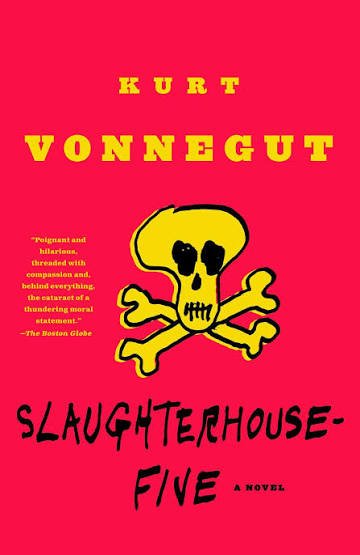
A memorable World War II satire set around the events of the infamous Dresden bombing. We follow the author himself in the introduction and then we read most of the story through Billy Pilgrim. „It’s partly true”, as Vonnegut mentions in the beginning. The true part was that he did serve on the European front and he was in Dresden and did survive. The character of Billy Pilgrim is fictional, and through him we have this amnesiac type of storytelling where he travels through different timelines—his childhood, before the war, during the war, after the war, etc.
In short: Pilgrim went crazy after the war and thinks he saw Tralfamadorians, a species of aliens that see time „the way we can see the layers of the Rocky Mountains—all at once.” To them time is a fixed concept, and the world is entirely predetermined. „All moments, past, present, and future, always have existed, always will exist.” All things happen exactly as they do, and they will always happen that way, and they will never happen any other way. Time is all at once. The aliens, incidentally, admit to destroying the universe in a comical accident fated far into the future, and they're very sorry, but „so it goes.”
So to add to this chaos, Pilgrim becomes aware that his life is predetermined once he meets those aliens, thus he experiences all these time travels from this new point of view. Obviously, everyone thinks he went nuts, and so he doesn’t talk much during this novel; he observes and is being dragged along without much intention in his actions.
The main thing that stands out for me is Vonnegut’s excellent satire and somewhat sporadic and extremely dry style of writing. This style is almost self-mocking—and there’s plenty of self-mockery in this story: from irony to pure comedy, to tragedy, and to tragically funny. There’s so much absurdism in this one that Camus’ The Stranger seems like a walk in the park. The Stranger is undoubtedly more beautifully written, but Vonnegut’s choice of style seems to be intentional—it only emphasizes the absurdity of the story. That may be to someone’s liking, others may hate this satire. I thought it was well done, even too crude sometimes, to the point where it reminded of the intense tragedy of it all, given the real life setting.
To prove the point, I would highlight some parts of it, which don’t really spoil the story, but highlight the dry style, the juxtapositions and the ubiquitous satire:
Roland Weary and the scouts were safe in a ditch, and Weary growled at Billy, “Get out of the road, you dumb motherfucker.” The last word was still a novelty in the speech of white people in 1944. It was fresh and astonishing to Billy, who had never fucked anybody—and it did its job. It woke him up and got him off the road. (p. 36)
Billy and the scouts were skinny people. Roland Weary had fat to burn. He was a roaring furnace under all his layers of wool and straps and canvas. He had so much energy that he bustled back and forth between Billy and the scouts, delivering dumb messages which nobody had sent and which nobody was pleased to receive. He also began to suspect, since he was so much busier than anybody else, that he was the leader. (p. 44)
One scout hung his head, let spit fall from his lips. The other did the same. They studied the infinitesimal effects of spit on snow and history. (p. 52)
Now they were dying in the snow, feeling nothing, turning the snow to the color of raspberry sherbet. So it goes. (p. 57)
On the eighth day, the forty-year-old hobo said to Billy, “This ain’t bad. I can be comfortable anywhere.” “You can?” said Billy. On the ninth day, the hobo died. So it goes. His last words were, “You think this is bad? This ain’t bad.” (p. 82)
The coat that Billy Pilgrim got had been crumpled and frozen in such a way, and was so small, that it appeared to be not a coat but a sort of large black, three-cornered hat. There were gummy stains on it, too, like crankcase drainings or old strawberry jam. There seemed to be a dead, furry animal frozen to it. The animal was in fact the coat’s fur collar. (p. 85)
“You know—we’ve had to imagine the war here, and we have imagined that it was being fought by aging men like ourselves. We had forgotten that wars were fought by babies. When I saw those freshly shaved faces, it was a shock. ‘My God, my God—’ I said to myself, ‘It’s the Children’s Crusade.’ ” (p. 109)
He changed the subject now, congratulated Valencia on her engagement ring. “Thank you,” she said, and held it out so Rosewater could get a close look. “Billy got that diamond in the war.” “That’s the attractive thing about war,” said Rosewater. “Absolutely everybody gets a little something.” (pp. 114-115).
“You needn’t worry about bombs, by the way. Dresden is an open city. It is undefended, and contains no war industries or troop concentrations of any importance.” (p. 150)
She was a dull person, but a sensational invitation to make babies. Men looked at her and wanted to fill her up with babies right away. She hadn’t had even one baby yet. She used birth control. (p. 175)
One of my favorite parts in the novel is this paragraph where Vonnegut presents a simple and ironic mental exercise; I call it „War backwards”:
He went into the living room, swinging the bottle like a dinner bell, turned on the television. He came slightly unstuck in time, saw the late movie backwards, then forwards again. It was a movie about American bombers in the Second World War and the gallant men who flew them. Seen backwards by Billy, the story went like this: American planes, full of holes and wounded men and corpses took off backwards from an airfield in England. Over France, a few German fighter planes flew at them backwards, sucked bullets and shell fragments from some of the planes and crewmen. They did the same for wrecked American bombers on the ground, and those planes flew up backwards to join the formation. The formation flew backwards over a German city that was in flames. The bombers opened their bomb bay doors, exerted a miraculous magnetism which shrunk the fires, gathered them into cylindrical steel containers, and lifted the containers into the bellies of the planes. The containers were stored neatly in racks. The Germans below had miraculous devices of their own, which were long steel tubes. They used them to suck more fragments from the crewmen and planes. But there were still a few wounded Americans, though, and some of the bombers were in bad repair. Over France, though, German fighters came up again, made everything and everybody as good as new.
When the bombers got back to their base, the steel cylinders were taken from the racks and shipped back to the United States of America, where factories were operating night and day, dismantling the cylinders, separating the dangerous contents into minerals. Touchingly, it was mainly women who did this work. The minerals were then shipped to specialists in remote areas. It was their business to put them into the ground, to hide them cleverly, so they would never hurt anybody ever again. The American fliers turned in their uniforms, became high school kids. And Hitler turned into a baby, Billy Pilgrim supposed. That wasn’t in the movie. Billy was extrapolating. Everybody turned into a baby, and all humanity, without exception, conspired biologically to produce two perfect people named Adam and Eve, he supposed. (pp. 77-78)
Vonnegut, the author, mentions towards the end of the novel:
There are almost no characters in this story, and almost no dramatic confrontations, because most of the people in it are so sick and so much the listless playthings of enormous forces. One of the main effects of war, after all, is that people are discouraged from being characters. (p. 168)
The novel reads like a traumatic experience, but in a detached, satiric way. I wouldn’t say it’s necessarily anti-war, more like a passive acceptance of things you can’t change. At its heart, it’s a stoic acceptance of life’s cruelties while simultaneously laughing at your own helplessness.
Rating: 4/5