Cal Newport: Deep Work - book review
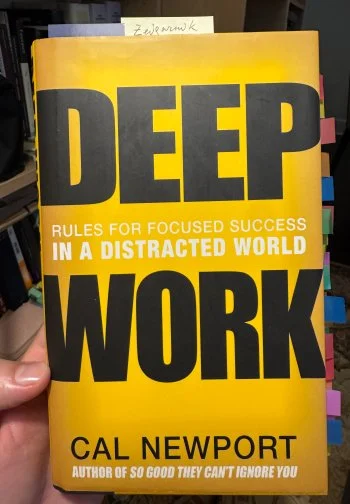
As in most self-help books, it’s mostly common sense, however, this one is kind of an exception. It actually has lots of practical advice and it deepened my insights on how I can consistently „switch into deep work mode”; Newport also mentioned a few research studies in the fields of psychology and neuroscience. (not too many though, which may be a bit disappointing to some)
About 1/3 of the book is theory, and the rest is practical advice and examples—which I loved! Cal Newport’s dry and pragmatic style of writing was fitting for this kind of book. Definitely not a memorable style of writing, but it did its job here. It made me think about new approaches to being focused and being more productive with my time.
Some advice I’m already applying: I’ve started scheduling and tracking the amount of „deep work” I’m doing (which in my case is reading and writing) and calculating the averages and seeing tendencies of my behavior; after some time I will see which philosophy of work is more efficient in my particular case. (more on that below)
Overall, it made me more aware of how I use my time and how I distract myself. Some decent research and anecdotes on different people and their style of „working deep”: Carl Jung, Bill Gates; some journalists and writers like Adam Grant, Alan Lightman and others.
To get to the meat of the book, here’s some scattered notes I’ve made:
Deep Work = Professional activities performed in a state of distraction-free concentration that push your cognitive capabilities to their limit.
“In work, and especially in knowledge work, to increase the time you spend in a state of depth, is to leverage the complex machinery of the human brain, in a way that—for several different neurological reasons—maximizes meaning and satisfaction you’ll associate with your working life.”
“The best moments usually occur when a person’s body or mind is stretched to its limits in a voluntary effort to accomplish something difficult or worthwhile.”—this was an idea developed by Mihaly Csikszentmihalyi. He calls this mental state “flow”—a term he popularized in the 1990’s with a book with the same name. At the time, this finding pushed back against conventional wisdom. Most people assumed, and still do, that relaxation makes them happy: we want to work less, spend more time in the hammock, but the results from Csikszentmihalyi’s studies reveal that most people have this wrong. “Ironically,” he writes, “jobs are actually easier to enjoy than free time, because like flow activities they have built-in goals, feedback rules and challenges, all of which encourage one to become involved in one’s work, to concentrate and lose oneself in it. Free time, on the other hand, is unstructured, it requires much greater effort to be shaped into something that can be enjoyed.”
Neal Stephenson: “If I organize my life in such a way that I get lots of long, consecutive, uninterrupted time-chunks, I can write novels. If I instead get interrupted a lot, what replaces it? A bunch of e-mail messages that I have sent out to individual persons.”
“The task of the craftsman is not to generate meaning, but rather to cultivate in himself the skill of discerning the meanings that are already there. This frees the craftsman of the nihilism of autonomous individualism, providing an ordered world of meaning.”
Our work culture’s shift toward the shallow is exposing a massive personal opportunity for the few who recognize the potential of resisting this trend and prioritizing depth.
The neuroscience of deliberate practice: By focusing intensely on a specific skill, you’re forcing the specific relevant circuit to fire, again and again, in isolation. This repetitive use of a specific circuit triggers the wrapping layers of myelin around the neurons in the circuits - effectively cementing the skill. The reason, therefore, why it’s important to focus intensely on the task at hand while avoiding distraction is because this is the only way to isolate the relevant neural circuit enough to trigger useful myelination. By contrast, if you’re trying to learn a complex new skill in a state of low concentration, you’re firing too many circuits simultaneously and haphazardly to isolate the group of neurons you actually want to strengthen.
Move beyond good intentions and add routines and rituals to your working life.
Minimize the amount of willpower necessary to maintain unbroken concentration.
Commit to a particular pattern for scheduling this work and develop rituals to sharpen your concentration before starting each session.
Choose a philosophy that fits your circumstances:
The monastic philosophy of deep work scheduling attempts to maximize deep efforts by eliminating or radically minimizing shallow obligations. To have a well-defined and highly valued professional goal that they’re pursuing, and the bulk of their professional success comes from doing this one thing exceptionally well.
Jung did not deploy a monastic approach only during the periods he spent at his retreat. The rest of Jung’s time was spent in Zurich. He ran a busy clinical practice that often had him seeing patients until late at night; he was an active participant in the Zurich coffeehouse culture; and he gave and attended many lectures.
This philosophy asks that you divide your time, dedicating some clearly defined stretches to deep pursuits and leaving the rest open to everything else. During the deep time, act monastically - seeking intense and uninterrupted concentration.
The minimum unit of time for deep work in this philosophy tends to be at least one full day. To put aside a few hours in the morning, for example, is too short to count as a deep work stretch for an adherent of this approach.
Bimodal philosophy is typically deployed by people who cannot succeed in the absence of substantial commitments to non-deep pursuits.
Jung, for example, needed his clinical practice to pay the bills and the Zurich coffeehouse scene to stimulate his thinking.
Adam Grant would, perhaps once or twice a month, take a period of two to four days to become completely monastic. Outside of these deep sessions, Grant remained famously open and accessible. (thus, he used bimodal philosophy)
The rhythmic philosophy: transform deep work sessions into a simple regular habit. He would wake up and start working by five thirty every morning. He would then work until seven thirty, make breakfast, and go to work: “both astronomically productive and guilt free.”
This approach works better with the reality of human nature.
If you’re writing with no one pressuring you to get it done, the habitual nature of the rhythmic philosophy might be necessary to maintain progress.
The journalist philosophy (advanced difficulty): in which you fit deep work wherever you can into your schedule. Journalists are trained to shift into a writing mode on a moment’s notice.
Newport on one of his journalist friends:
„Any time he could find some free time, he would switch into a deep work mode and hammer away at his book. He could retreat up to the bedroom for a while, when the rest of us were chilling on the patio or whatever, to work on his book… he’d go up for twenty minutes or an hour, we’d hear the typewriter pounding, then he’d come down as relaxed as the rest of us… the work never seemed to faze him, he just happily went up to work when he had the spare time.”
Ignore inspiration. Waiting for inspiration to strike is a terrible plan.
Another strategy: the grand gesture. A radical change to your normal environment coupled with a significant investment of effort or money, all dedicated toward supporting a deep work task. (obviously for the rich boys)
MIT physicist and award-winning novelist Alan Lightman retreats each summer to a “tiny island” in Maine. The island not only lacked Internet, but didn’t even have phone service. “Recover some silence which is so hard to find.”
Newport brings the example of Clayton Christensen’s book titled „The 4 Disciplines of Execution” for successfully implementing high-level strategies (or disciplines).
Discipline #1: Focus on the Wildly Important
The more you try to do, the less you actually accomplish. Don’t try to say ‘no’ to the trivial Say ‘yes’ to the ambitious and crowd out everything else.
Discipline #2: Act on the Lead Measures
Measure your success: lag measures and lead measures. Lag measures describe the thing you’re ultimately trying to improve. they come too late to change your behavior Lead measures measure the new behaviors that will drive success on the lag measures. I used to focus on lag measures, such as papers published per year. These measures, however, lacked influence on my day-to-day behavior because there was nothing I could do in the short term that could immediately generate a noticeable change to this long-term metric. When I shifted to tracking deep work hours, suddenly these measures became relevant.
Discipline #3: Keep a Compelling Scoreboard
Nepwort kept track of the hours spent in deep work, and taped it to the wall next to his computer monitor (where it couldn’t be ignored), circled the hour where he finished an important milestone. It helped calibrate his expectations for how many hours of deep work were needed per result. (I started doing something similar)
Discipline #4: Create a Cadence of Accountability
Weekly review in which you make a plan for the workweek ahead.
Execution is more difficult than strategizing. These basic disciplines seem to work particularly well in conquering this difficulty.
Some decisions are better left to your unconscious.
To actively try to work through these decisions will lead to a worse outcome.
a) For decisions that require the application of strict rules, the conscious mind must be involved.
b) For decisions that involve large amounts of information and multiple vague, and perhaps even conflicting, constraints, use your unconscious.
If you keep interrupting your evening to check e-mail, you’re robbing your directed attention centers of the uninterrupted rest they need for restoration.
Trying to squeeze a little more work out of your evenings might reduce your effectiveness the next day.
People who multitask all the time can’t filter out irrelevancy. (we are bad at multitasking)
Once your brain has become accustomed to on-demand distraction, it’s hard to shake the addiction even when you want to concentrate.
If every moment of potential boredom is relieved with a quick glance at your smartphone, then your brain has likely been rewired to a point where it’s not ready for deep work - even if you regularly schedule time to practice this concentration.
The constant switching from low-stimuli/high-value activities to high-stimuli/low-value activities, at the slightest hint of boredom or cognitive challenge, that teaches your mind to never tolerate an absence of novelty.
Bias your time toward depth.
There’s other stuff that I’ve missed but I think this is quite enough for this long-ass unstructured review.
Rating: 4/5