Robert Pirsig: Zen and The Art of Motorcycle Maintenance - book review
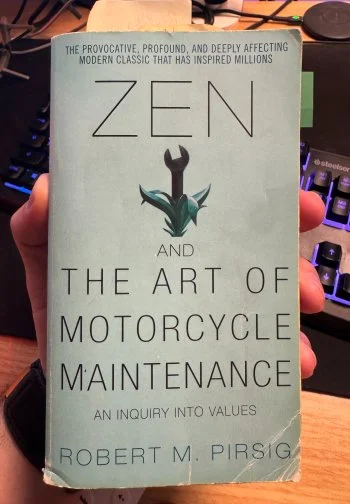
Wow, what an adventure this book was. It’s a lot to take in, and it took me a while to finish it, with lots of breaks. There’s so much in it that it’s making it really hard for me to summarize it, as in trying to do so I know I would be doing it a great disservice. Still, it’s a rare example of how a philosophical novel (though in an unusual and somewhat clunky format) can be accessible, engaging and profound at the same time. The scattered format may be due to the fact that the novel form is used as a platform to present philosophical ideas. The characters in the book are pretty bland and not too detailed—their feelings and psychology were not always clear, but I was okay with that, I was more interested in the natural landscapes and the philosophical monologues—but if you dislike this aspect, this book is not for you.
In my opinion, this book is still very relevant—it’s a nuanced argument against a binary and “square” way of thinking in the modern age.
The title, though, is slightly misleading. It’s not a Zen Buddhism handbook, and it’s definitely not a manual on how to repair a motorcycle. And yet, at the same time, it sort of is. (I know, what the hell?) What I mean is… it’ still about Zen, but kind of on the surface. It lightly touches some aspects of Zen and expands on them in long paragraphs and brings analogies to the Western thought—which may be annoying for some people, but I liked the rants.
The way the book is written, it really is a trip, both literally and metaphorically. There’s so much nuance in it that I’m afraid it loses its essence if you try to pin it down to specifics. But I’ll give you an overview without spoiling anything, so you could decide for yourself if it sparked your interest.
The book is literally a trip because in the story (based on real life events, though partially fiction) we follow Robert and his son on a 17-day motorcycle journey from Minnesota to Northern California, and it’s metaphorically a trip because beside the physical descriptions of it we have Robert’s philosophical and psychological ruminations which I would argue are even more fascinating than the physical trip. The great tension of this novel lies in Robert’s troubled past—he had fought with mental illness, and from what it seems during the trip, he didn’t win definitively, he still has moments where his alter-ego (which he calls Phaedrus) is creeping into his thoughts.
I won’t spoil anything but I can only assure you that the tension is there throughout the book and there’s always an eerie feeling of uncertainty which keeps you engaged and slightly terrified. The hint of madness never fully evaporates (his relationship to his son is troublesome) and neither does the thorough dissection of Western thought, how it originated, what are its shortcomings, and what are its philosophies. The more you read this book the deeper you go into the slow process of defragmentation of your thoughts and your values in life. The narrator is like a surgeon that penetrates the recesses of your mind—which may have laid dormant for years, if not even decades—by putting a mirror in front of you and (gently) forcing you to question what you’ve taken for granted all this time.
The scope of this book is broad and gets quite heavy at times: the ruminations on differences between classical knowledge and romantic knowledge was really fascinating, as where the talks on metaphysics of Quality. There was also a bit of Kant, Poincare, Zen Buddhism, Ancient Greeks (Pre-Socratics, Socrates, Plato, Aristotle), mythology, the nature of thought, types of thought, “mental traps”, how our interaction with technology is affecting our world-view and so much more that I may have missed. Yet, in enumerating all this, I really only touched the surface, because this book excels not so much in scope as in its ambition to go deep into some uncharted topics, maybe even too deep for its own sake, spinning in a kind of mental circle in some of its arguments. It was still definitely thought-provoking, maybe not always for the good reasons (his confidence in solving a few dilemmas of the Ancient Greeks sounds too good to be true). I would often pause and ruminate on what’s been said, sometimes for hours or even days at a time. I didn’t agree with everything he said, but he made me think about things I haven’t thought before, and that was valuable to me.
A point that Pirsig is making in his book is that there is no separation in your life. The motorcycle becomes a metaphor for how we deal with this reality: “The real cycle you’re working on is a cycle called ‘yourself’.” Do we pretend that we are separate and become spectators to our own play (as Descartes did in the 17th century, thus essentially founding modern philosophy, which separates the mind from the body), or do we jump in with attentiveness, awareness, and care, the same way a good mechanic does when troubleshooting an issue?
"The difference between a good mechanic and a bad mechanic, like the difference between a good mathematician and a bad one, is precisely this ability to select the good facts from the bad ones on the basis of quality. He has to care! This is an ability about which formal traditional scientific method has nothing to say. It’s long past time to take a closer look at this qualitative preselection of facts which has seemed so scrupulously ignored by those who make so much of these facts after they are “observed.” I think that it will be found that a formal acknowledgment of the role of Quality in the scientific process doesn’t destroy the empirical vision at all. It expands it, strengthens it and brings it far closer to actual scientific practice." (p.288)
Written in 1974, it sold millions of copies and inspired readers to look deeper into their relationship with themselves and the world around them, not to mention the subsequent motorcycle trips across US that were inspired from this book in the next few decades. And yet, Robert Pirsig received a remarkable 121 rejections before an editor finally accepted it for publication--and he did so thinking it would never make a bit of profit. Then it was on best-selling lists for decades.
Pirsig had never intended it to become so popular. “I was just telling my own story,” he said in a short interview.
“I expressed what I thought were my prime thoughts,” he added, “and they turned out to be the prime thoughts of everybody else.” A culture-bearing book is not necessarily a great book, he said. It does not change the culture. It simply heralds a change already underway.
New York Times described it as “Profoundly important…full of insights into our most perplexing contemporary dilemmas…Intellectual entertainment of the highest order.”
10 years after its publication, Pirsig reflected in the Afterword:
“This book also appeared at a time of cultural upheaval on the matter of material success. Hippies were having none of it. Conservatives were baffled. Material success was the American dream. Millions of European peasants had longed for it all their lives and come to America to find it—a world in which they and their descendants would at last have enough. Now their spoiled descendants were throwing that whole dream in their faces, saying it wasn’t any good. What did they want?
The hippies had in mind something that they wanted and were calling it 'freedom', but in the final analysis 'freedom' is a purely negative goal. It just says something is bad. Hippies weren’t really offering any alternatives other than colourful short-term ones, and some of these were looking more and more like pure degeneracy. Degeneracy can be fun but it’s hard to keep up as a lifetime occupation.
This book offers another, more serious alternative to material success. It’s not so much and alternative as an expansion of the meaning of 'success' to something larger than just getting a good job and staying out of trouble. And also something larger than mere freedom. It gives a positive goal to work towards that does not confine. That is the main reason for the book’s success, I think. The whole culture happened to be looking for exactly what this book has to offer. That is the sense in which it is a culture-bearer.”
Rating: 4.5/5