Søren Kierkegaard: Fear and Trembling - book review
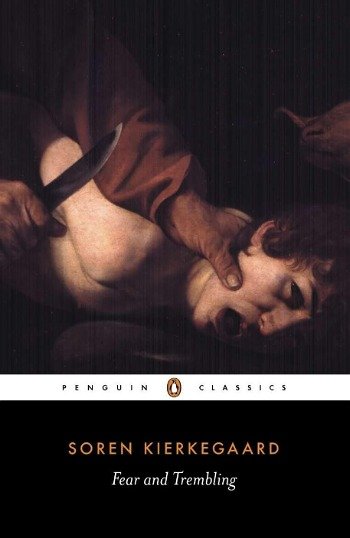
I like Kierkegaard, but man does he need an editor—there’s too much repetition in his thoughts, even though he is undeniably a great writer.
As an agnostic, this book was particularly interesting (and challenging) to me because Kierkegaard is a complex character: a Christian, but a very skeptical and unusual one (he criticized modern Christianity and was ostracized by the Danish Church). It was interesting from a few different perspectives:
1. The Biblical story of Abraham being willing to sacrifice his own son Isaac—an order (a test, as is later revealed) from God; a truly absurd concept, and Kierkegaard analyzed it to the bone. I don’t believe that any other writer even attempted what Kierkegaard did—I’m sure I could never write so thoroughly on such an absurd topic, and this is precisely why Kierkegaard is unique.
2. The paradox of faith, that „the particular is higher than the universal” (p. 77) is such a subjective term that not even many believers can explain (and Kierkegaard argues that it’s unexplainable), and it intrigues me, to say the least.
3. The differences between a tragic hero—typical in Greek mythology; a hero who usually sacrifices himself for the universal (for others) and a „knight of faith”—one who is in constant tension with himself and the outside world; there is no resolution, no tears and no applause from others, because he „cannot speak”, cannot make himself intelligible to others (very Kafkaesque if I may say).
The gist of the Biblical story of Abraham is this:
„And God tempted Abraham and said unto him, Take Isaac, thine only son, whom thou lovest, and get thee into the land of Moriah, and ofer him there for a burnt offering upon the mountain which I will show thee.” (p. 7)
So Abraham takes Issac and they ride in silence for three days. Isaac could never understand him, why he would need to sacrifice him, so Abraham didn’t speak much. When they got to the top of the mountain, „Abraham lifted the boy, he walked with him side by side, and his talk was full of comfort and exhortation. But Isaac could not understand him. He climbed Mount Moriah, but Isaac understood him not. Then for an instant he turned away from him, and when Isaac again saw Abraham’s face it was changed, his glance was wild, his form was horor. He seized Isaac by the throat , threw him to the ground...” (p. 9) but then he „saw the ram which God had prepared. Then he offered that and returned home. ... From that time on Abraham became old, he could not forget that God had required this of him. Isaac throve as before, but Abraham’s eyes were darkened, and he knew joy no more.” (p. 10)
So Isaac’s sacrifice, it turns out, was a test (It’s just a prank, bro). It’s truly an absurd story. A loving father is ordered by God to sacrifice his only son, and Abraham is ready to do it—no, he is pretty much with the knife at Isaac’s throat before he sees the ram that is to be sacrificed to God. Why would God be so cruel, we would ask? Why would Abraham follow such an absurd order? Is he delusional? Is he mad? How could he bring himself to almost kill his only son?
Kierkegaard himself says that „I cannot understand him, I can only admire him” (p. 171). And he further expands, „...though Abraham arouses my admiration, he at the same time appals me.” (p. 87)
And I don’t understand Abraham either, but I can’t say I admire him, I am rather terrified by him. I am terrified that a man would be ready to kill his own son to prove his love to God.
Therefore, Kierkegaard argues, Abraham is not a tragic hero, a tragic hero doesn’t live in a paradox, because he lives ethically, „The tragic hero does not enter into any private relationship witht he deity, but for him the ethical is the divine, hence the paradox implied in this situation can be mediated in the universal.” (p. 86)
Abraham is instead a „knight of faith”, who lives in „isolation and constant dread”:
„Humanly speaking, he is crazy and cannot make himself intelligible to anyone.” (p. 112)
„The hero does the deed and finds response in the universal, the knight of faith is kept in constant tension.” (p. 117)
„The knight of faith has only himself alone, and this constitutes the dreadfulness of the situation.” (p. 116)
„The knight of faith...is the paradox, is the individual, absolutely nothing but the individual, without connections or pretentions.” (p. 118)
I don’t know, to me the burden of being a knight of faith is too heavy, it seems almost inhuman. It’s a very lonely path indeed. At first, it seemed to me like this concept of „the knight of faith” is a justification for Kierkegaard’s own isolation, but then he admits that he is not a knight of faith; and although he admires Abraham, he cannot „think” of him, because he cannot be thought, he is asburd, he is „at no instant a tragic hero but something quite different, either a murderer or a believer.” (p. 81)
Abraham’s life is so paradoxical that it cannot be „thought” at all, in a way he is the metaphor for faith, because faith is a paradox in which you go beyond rationality: „He [Abraham] believed by the virtue of the absurd; for all human reckoning ceased to function.” (p. 45)
Abraham believed „by the virtue of the absurd” because he was ready to sacrifice his own son, even though at the same time he loved him deeply:
„...he believed that God would not require Isaac of him, whereas he was willing nevertheless to sacrifice him if it is required. He believed by the virtue of the absurd.” (p. 41)
And this is (from what I understand) one of the main points that Kierkegaard tries to argue in the book: that we should stop at faith, that there is no need to explain the unthinkable. That we should embrace the paradox, the dread and the anxiety that comes with it; because faith is a passion and our true selves are revealed in our passions. In other words, faith begins precisely where reason ends.
This, in essence, is a criticism towards Hegel, a German philosopher that influenced European thought in the late 18th and 19th centuries—which was all about great rational systems that explain all human history and thought (including God). Hegel believed that if we rationally understand the Universe, we would understand God; while Kierkegaard believed that God and faith is intelligible to the human mind: „for in temporal world God and I cannot talk together, we have no language in common.” (p. 41)
Kierkegaard is right in saying that we cannot „think” of Abraham, he is truly absurd, thus he is the father of the Judaeo-christian faith. I’d even say that Abraham is faith itself, a solitary, paradoxical, and dreadful existence (especially nowadays in our secular, post-„God is dead”-world).
Ethically speaking, Abraham was ready to be a murderer, religiously speaking, it was a sacrifice—and this is the contradiction that contains the dread without which Abraham wouldn’t be Abraham. Dread is the essential part of being „a knight of faith”.
I don’t know how we should interpret this Biblical story. Is it literal? Is it metaphorical? I can’t fully grasp it.
Nor can I feel sorry for Abraham, like I would for a tragic hero, I can only feel astonished and terrified by him. „One cannot weep over Abraham. One approaches him with a horror religiosus, as Israel approached Mount Sinai.” (p. 88)
I personally don’t agree with Kierkegaard’s conclusion, that Abraham transcended the ethical and lives in a paradox where „an individual stands in an absolute relation to the absolute”, I think Abraham is just lost. But then that’s just me.
Either way, this book is a fascinating attempt at interpreting this absurd Biblical story, and even though I don’t buy the conclusion, I will get back to re-reading parts of it, as it’s a difficult but engaging work by an extremely intelligent writer.
Rating: 4/5