William Shakespeare: King Lear - book review
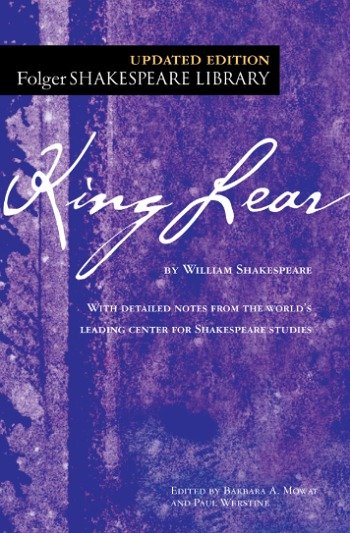
“When we are born, we cry that we are come
To this great stage of fools.” (4.6. 185)
Considered one of Shakespeare’s greatest tragedies, King Lear is a story of power, foolishness, loss and … death, lots of death. It has some memorable and difficult verse, with lots of archaic words, which felt like digging into an archaeological site at each page. But it was worth it—even if the language was difficult, the story was engaging.
King Lear gets to a ripe old age and is tired of managing good ol’ England so he decides to give executive power to his daughters Goneril and Regan (both of whom would be called “ass-kissers” in our modern age), while ignoring Cordelia, the only daughter who was actually honest with her father and who questioned his decisions. Lear doesn’t like anyone questioning his authority (he’d rather have the perception of being liked than the honest truth) so he kicks Cordelia out and sends her to be married with either the King of Burgundy or the King of France.
Lear’s right-hand, Kent, sides with Cordelia and warns the king against rash and foolish decisions, but then Lear kicks him out too (of course).
On the other side of the story, one of King Lear’s subordinates, Duke of Gloucester is being plotted against as well: His bastard son, Edmund, faked a letter in which it is revealed that Edgar, Gloucester’s rightful son, wants to kill Gloucester. Duke of Gloucester, naturally, is angered and sends the guards after Edgar, who in turn escapes and decides to disguise himself as a “poor Tom” (a homeless dude, essentially).
Back to King Lear. He finds out that Goneril and Regan got power hungry and are plotting to kick their own father out, arguing that he’s too old and foolish to be a King (which is not an unsubstantiated opinion). Then to further confirm his daughters’ theory, Lear goes on a mad rant and runs into the open country toward the French camp (where Cordelia went) in the middle of a heavy storm, followed by a Fool (who probably has the best and the funniest lines in the play) and the disguised Kent, who faked his way back into being King’s right arm, without revealing his real identity (he figured ass-kissing is the way to go with Lear).
Meanwhile, Gloucester finds out about Lear’s troubles and tries to help him out but Regan and her husband Cornwall catch him on the way to the French camp and consider him a traitor. Cornwall challenges him to a fight which results in Cornwall’s death and Gloucester’s eyes being plucked out and him getting kicked out to die in the country. Edgar (Gloucester’s rightful son, remember?) finds the blind Gloucester and guides him back to shelter, without revealing his own identity.
Hidden identities, loss of sight, and a certain “irony of fate” is a common theme in this tragedy. In this case the irony is that Gloucester was “blind” to Edgar’s devotion when he had eyes, and only valued Edgar when he actually became blind: paradoxically, his eyesight was an impediment to finding out the truth. And the same can be said about King Lear—even if he had sight, he was probably the “blindest” men of them all.
Now, back to Cordelia and her French camp. She decides to gather an army and go save her father. So the French and the English fight, but Cordelia loses, and Regan with Goneril win the battle, taking their sister Cordelia and their father Lear as prisoners. Edmund (the bastard son to Gloucester) orders a guard to kill Cordelia by staging it as a suicide, while Goneril decides to poison her sister Regan out of jealousy for Edmund, but then is found out so she decides to poison herself too. So all three sisters are dead now. But can it get worse? Pfft, of course it can, it’s a Shakespeare tragedy after all!
The last scene is King Lear carrying the dead body of Cordelia and weeping over her (realizing his mistakes?), while cursing everyone around him:
“O, you are men of stones:
Had I your tongues and eyes, I’d use them so
That heaven’s vault should crack. She’s gone for ever.” (5.3. 260)
Then he suddenly has what seems like a heart attack and dies. The end.
It’s one of those stories where you say to someone jokingly “everyone dies at the end” and you’re not actually joking.
I’m yet to see an enacted play of this tragedy and I think I would definitely like it even more in a theatrical environment. Reading it was slow and difficult (to say the least), but I appreciated how ironic and unexpectedly funny it was. The swear words alone made my jaw drop a few times (Shakespeare was creative in that department too), and some lines were very memorable.
The story is tragic because there’s no resolve in the tension between the family members, they all die due to circumstances that are a mixture of something they could control and something they could not control.
This is where Shakespeare’s writing excels—in the ambiguity of the moral lessons of the story: one could argue that it was Lear’s foolishness that killed them all, or one could say that it was a random string of events that are outside the boundaries of human agency—there’s lots of references to the stars and the planets; astrology was popular back then and people took it more seriously than nowadays, “It is the stars, the stars above us, [that] govern our conditions.” (4.3. 35)
Fate is in conflict with small human decisions that may alter the course of many lives, and we as viewers are left to decide which has more influence over the story.
In this sense, the play seems like a homage to Greek tragedies—it certainly reminded me of Antigone by Sophocles, for example.
Just like in real life (but more dramatic), things are left unresolved, people do foolish things due to emotions, and good intentions are often misunderstood or manipulated. The capacity to do evil or good are in each one of us, but those capacities are often affected by our momentary disposition, and not just by our moral compass.
We like to think of ourselves as someone who decides our own life’s course, but in the grand scheme of things we are just pawns of the universe being thrown around until eventually we all meet the absolute certainty of death.
Rating: 4/5