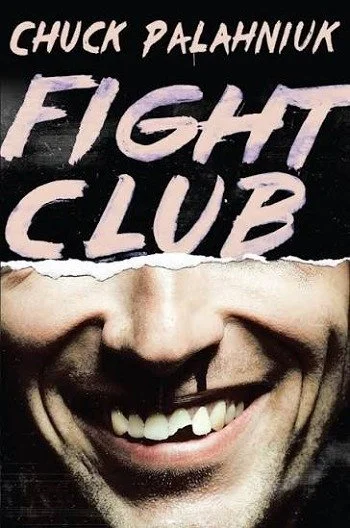
Chuck Palahniuk: Fight Club - book review
“Advertising has these people chasing cars and clothes they don’t need. Generations have been working in jobs they hate, just so they can buy what they don’t really need. We don’t have a great war in our generation, or a great depression, but we do, we have a great war of the spirit. We have a great revolution against the culture. The great depression is our lives. We have a spiritual depression.” (p. 149)
There’s much that’s been said about this book, and even more about the movie, and although I’ve already watched the movie a long time ago (probably twice or so), I only got to read the book now and I didn’t read any reviews so what’s followed is my own impression.
This book is like a hammer that slams you on the head and wakes you up from the deep slumber of your everydayness with your peaceful consumerist and Netflix-binging, Facebook-posting, and politics-complaining-while-doing-nothing-about-it self. It’s such and entertaining and unrelenting slam that you just wish it were longer, you just keep saying “yes, slam that shit on me, I need more tough love”. Or maybe it’s just me, I don’t know. But this book is even more relevant now than in the late 90’s, because its themes are more severe nowadays: the fatherless generation of men, consumerism, lack of belonging to a community, nihilism, lack of willpower and the overall drag of our self-induced frustration from our boring lives.
It’s part satire, part romantic story (at least that’s what Palahniuk himself claims in the Afterword), part anti-consumerist rant, and just an overall aesthetically pleasing fiction, very disturbing at times, but in a good way. It’s all in good humour, but it is also serious when it needs to be.
The plot is well-known—the protagonist has a boring office job and is too tired of his “complete life” and decides to go to random terminal cancer gatherings and pretend he’s terminally ill so he could feel better about himself. The groups are sarcastically named: “Remaining Men Together”, “Firm Believers leukemia rap group”, “Above and Beyond”. Soon enough, he spots another “faker” that goes to almost every meeting as well: Marla. She annoys him because every time he wants to cry at those meetings he can’t because she stares at him and he knows that she knows that he’s a faker.
At one point they both argue that they should got to different meetings. They try to make a deal but Marla refuses, she wants it all, all the second-hand suffering. It’s a great satire on the catharsis we get from being among people who have it worse than us:
“No, she wants it all. The cancers, the parasites. She never dreamed she could feel so ‘smarvelous. She actually felt alive. Her skin was clearing up. All her life, she never saw a dead person. There was no real sense of life because she had nothing to contrast it with. Oh, but now there was dying and death and loss and grief. Weeping and shuddering, terror and remorse. Now that she knows where we’re all going, Marla feels every moment of her life.” (p. 38)
Same goes with him. Seeing dying people at these meetings liberated him, at least for a while:
“This was freedom. Losing all hope was freedom. If I didn’t say anything, people in a group assumed the worst. They cried harder. I cried harder. Look up into the stars and you’re gone.” (p. 22)
Mortality is a very prevalent leitmotif in this novel. It’s a sort of modernized “memento mori”—the mantra the ancient Stoics used to say, which translates to “remember death”, it encourages you to meditate on your own death so you could put things into perspective. They argue that if you see death or think about death more often, you start to appreciate the simple things in life. You realize that constant change is the norm and that death is all around you. It’s a cliché but clichés usually have some truth in them.
Probably the vaguest quote, but one that explains both our human lives and the entropy of the universe is one that’s pretty much copied from the ancient Greek Heraclitus: “Nothing is static. Everything is falling apart.” (p. 108)
Palahniuk often expresses anti-consumerist sentiments throughout the novel, and basically the whole arc of the protagonist is him slowly realizing that “he is not his job or his things”:
“You buy furniture. You tell yourself, this is the last sofa I will ever need in my life. Buy the sofa, then for a couple years you’re satisfied that no matter what goes wrong, at least you’ve got your sofa issue handled. Then the right set of dishes. Then the perfect bed. Then drapes. The rug. Then you’re trapped in your lovely nest, and the things you used to own, now they own you.” (p. 44)
“A lot of young people try to impress the world and buy too many things. […] A lot of young people don’t know what they really want. […] they think they want the whole world. […] If you don’t know what you want, you end up with a lot you don’t.” (p. 46)
Then of course comes the famous “the first rule of fight club is you don’t talk about fight club”—The protagonist has constant insomnia, and when he thinks he’s asleep, his alter ego, Tyler Durden, is doing things for him. Durden is a more assertive, more aggressive version of him.
The initial philosophy of fight club is based on satisfying the need for “rough play”—from prehistoric times men needed to have fights or compete in something in order to mature. Even now in many tribal cultures there are similar rituals where a boy becomes a man only after passing a trial of sorts, usually something that’s physically painful.
Fight Club is just a modern version of that ritual, it’s a manifestation and a symptom of a lack of leadership and lack of belonging among men nowadays—it argues that in order to become you need to “hit rock bottom first”, you need to break down your illusions about reality and face the pain of existence:
“Maybe self-improvement isn’t the answer. Maybe self-destruction is the answer.” (p. 49)
It’s a very Nietzschean idea, destroying all your current values and building from the bottom up. One of the central ideas in Nietzsche’s philosophy is “the transvaluation of all values”—a century and a half ago he predicted the modern spiritual malaise, the nihilism that will follow once we realize that our old judeo-christian God is dead: our modern culture is very materialistic and scientific, which is a whole new way of approaching life if you look back at history—we may have quantum physics, the internet, and high-performance processors now, but we don’t know how to live anymore, we’ve lost God, and we don’t even realize it.
“What you see at fight club is a generation of men raised by women.” (p. 50)
This nihilistic approach to life is further exacerbated by the epidemic of fatherless homes: more and more kids are raised by single mothers nowadays, and that destabilizes a boy’s psyche from a young age: he lacks discipline and he lacks healthy male role-models in his life. So he is in a constant search for a “father”, be it God, or a politician, or a leader of sorts. That lack makes him vulnerable to tyrants and other types of assertive and manipulative men.
And that’s what basically happens further down the plot. Durden becomes a tyrant. Fight Club becomes a giant organization which sucks in desperate men and forces them to cause a ridiculous amount of anarchy and violence in order to prove their loyalty to the tribe. Durden’s aggressive and anarchic antics are taken too far, and the protagonist realizes he needs to stop him. What I draw from this is that every revolution, however noble in its intentions, eventually turns into chaos because human nature doesn’t change. The bigger the tribe the dumber people get. In case you haven’t watched the movie, I won’t spoil the end, though I’m sure you already heard about it.
The point of maturity comes when we realize that “maybe we didn’t need a father to complete ourselves” (p. 54) It’s a defiant statement, one that accepts the pain of being God-less and father-less. It is at this point that we can start to build anew, to build ourselves first and foremost. That’s the subtler message that I think many miss in this book and in the movie: that you’re mostly at fault, that no matter how many excuses you make, at the end of the day you’re the one making decisions and you’re the one that lives to see the consequences. Not your father, not God, not society. You, and you only.
It’s a harsh message, one that a strict father or an Old Testament God would tell you, but it’s one that is lacking these days where it’s all about your feelings and mental health and all that comforting stuff. Our society has swung too much on the feminine side, and it abandoned what was good in masculinity.
Fight Club is ultimately a manifesto for young men, it’s a plea to be courageous and to be brutally honest with yourself. It’s also a meditation on suffering and death. It may seem flashy in its execution and dirty in its language, but at its heart it is a deeply moving novel, one that has deservedly become a modern classic.
“We are not special.
We are not crap or trash, either.
We just are.
We just are, and what happens just happens.” (p. 207)
Rating: 5/5