Albert Camus: Caligula - book review
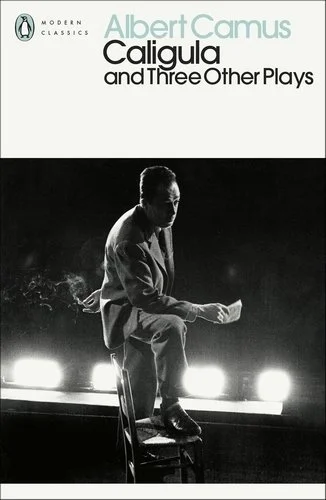
This theatre piece is based on a Roman emperor that ruled from 37 to 41 AD. Caligula, also known as Gaius, was described as a noble and moderate emperor during his first six months of his rule. But this has changed, as the few sources we have left are describing him as a cruel sadist, a sexual pervert and frankly as an insane tyrant. While it is hard to know how reliable these few sources are, it is known that he sought to increase the already considerable power that the emperor had in the Roman Empire, thus alienating the senators and patricians. He was eventually assasinated by a bunch of conspirators.
So within this already dramatic story, Camus sets the scene with his unequivocally attractive descriptions, psychological tensions and philosophical monologues, raising the drama to a level of an archetypal story — a story about an idealist who turns into a tyrant and causes misery to others.
The key question — and the main tension through which the plot is driven — lays in the motives of Caligula’s transformation: why did he turn into a tyrant? Was he justified? What does his nihilist philosophy tell us about the world and our place in it?
The play opens up with a few patricians in a State Room of the Palace, worried about Caligula’s disappearance. Caligula’s sister, Drusilla, has died, and people in Rome are contemplating the possibility that Caligula has lost his mind as a result (and that maybe Drusilla was more than a sister to him; yeah, hello Game of Thrones).
Scipio, one of Caligula’s friends, is worried about Caligula’s disappearance and is discussing the issue with Cherea (one of the patricians):
“I was there, following him as I usually do. He went up to Drusilla’s body. He stroked it with two fingers, and seemed lost in thought for a long time. Then he swung round and walked out, calmly enough… And ever since we’ve been hunting for him — in vain.” (p. 5)
Soon after Caligula appears in the scene: “his garments dirty, his hair wet, his look distraught”. He seems delirious to everyone around him. After an exchange with Helicon, — “his intimate friend” —, Caligula confesses he was searching hard for…the moon:
“Yes, I wanted the moon. (…) I’m not mad; in fact I’ve never felt so lucid. What happened to me is quite simple; I suddenly felt a desire for the impossible. That’s all. Things as they are, in my opinion, are far from satisfactory.” (p. 7)
Helicon responds to him by saying that many people share his opinion. Caligula notes this, and continues to talk about what seems like a utopia:
“Really, this world of ours, the scheme of things as they call it, is quite intolerable. That’s why I want the moon, or happiness, or eternal life — something, in fact, that may sound crazy, but which isn’t of this world” (p. 7).
To an untrained eye Caligula seems like a madman, like a delirious freak, a lunatic. However, he touches an important subject — a worry that most of us share. He realizes that human ideals don’t conform to how things are, or in other words: People are incapable of understanding the meaning of the world, thus it seems to them that the world is absurd. This absurd comes from the lack of purpose in the relationship between human actions and how the world works — it’s the “spiritual distance” that we feel from the cosmos, God, fate, or whatever you want to call it. Caligula, basically, becomes a nihilist — he loses his faith, his values and starts to question everything around him. As he put it bluntly: “Men die, and they are not happy.”
This, in essence, is The Absurd that Camus talks about in most of his works, and particularly, in the Myth of Sisyphus. Any honest man will face The Absurd at least once in his life, and in that moment his beliefs will be tested: will he retain his beliefs, will he improve them, or will he become a nihilist? — these are the main questions asked in the play, this is its philosophy; and this is the tension that runs throughout it.
Caligula, which is referred to by other people as an idealist, is slowly but surely becoming a cynical tyrant, proposing a complete change in how Rome should be run. Every patrician will be ordered to disinherit his children and leave his money to the State. More than that, whenever he fancies it, Caligula will order the death of any random citizen, and he can also modify that order whenever he wants. Who dies and who loses their money doesn’t matter, they’re all the same in the eyes of the nihilist Caligula. The man who will announce the order — an intendant — is trying to put some sense into Caligula, but in vain. The nihilist emperor, in a cynical and ironical fashion, is mocking people’s dependency on the State Treasury, on material things, so he takes it to the extreme by suggesting that what matters most is money and the State affairs; human life is of no importance:
“Obviously the order of their going has no importance, Or, rather, all these executions have an equal importance — from which it follows that none has any, Really all those fellows are on a par, one’s as guilty as another. (…) Now listen well, you fool! If the Treasury has paramount importance, human life has none. That should be obvious to you. People who think like you are bound to admit the logic of my edict and, since money is the only thing that counts, should set no value on their lives or anyone else’s. I have resolved to be logical, and I have the power to enforce my will. Presently you’ll see what logic’s going to cost you; I shall eliminate contradictions and contradictors.” (pp. 10-11)
Caligula is using logic to the absurd — he wants to punish people around him by “being logical”, by getting rid of his idealisms that brought him suffering in the past; it’s not an original story per se, as you can see similar types of tyrant antagonists in a lot of movies and stories — when the evil guy is being logical and is becoming a caricature of an atheist with no morals, an absurd pragmatist, a cynical executor of chaos (all that to prove a point to the “naïve people” around him).
Nevertheless, I don’t think Camus has set to be original when he was writing this play; the point was that the real-life story of Caligula eerily connected to Camus’ entire philosophy, or to be more exact, Caligula was that which Camus’ feared and fought against the most in his life. When he was a student he witnessed the Spanish Civil War, then when he got older he lived through the Rise of The Third Reich and he saw this philosophy of “logic” pushed to the absurd being played out in real life — with a cynical tyrant who became the embodiment of The Absurd on the front page of that tumultuous WW2 story. Taking this into context, there’s a reason why Camus’ entire body of work — in particular: The Fall and The Plague — is touching more or less on the same subject: the cynical nihilism which comes once we lose our hope, our purpose and all sense of beauty in this world. This is what Camus’ “revolt” was against, and this is what he feared the most. And Caligula is a play that embodies this fear in perhaps the most theatrical and dramatic way possible.
Caligula is ranting at one point about “equality” and how he hates men because they “are not free” — he wants to level everyone to the same cruelty of fate, but instead of waiting for fate to happen, he takes matters into his hands and acts as fate, or as God, or as the chaos of the cosmos (whatever notion suits you best). At this point he is the caricature of all utopian ideas smudged into one:
“I shall make this age of ours a kingly gift — the gift of equality. And when all is levelled out, when the impossible has come to earth and the moon is in my hands — then, perhaps, I shall be transfigured and the world renewed; then men will die no more and at last be happy.” (p. 14)
Then, ironically, he sentences to death a few men without a hearing, saying that “he’ll show them something they have never seen before, the one free man in the Roman Empire”. At this point, he has become a caricature of God, or some may say, God himself.
Act Two begins with Cherea and a few patricians discussing a potential coup — naturally, they want to stop Caligula, but they don’t know how to explain his madness. Why is he doing it?
Cherea, as I understand it, is Camus’ own personification in the story. Cherea’s philosophy closely aligns with what Camus personally thought during his life. Here’s Cherea trying to explain to another patrician why he’s fighting against Caligula:
“True, it’s not the first time Rome has seen a man wielding unlimited power; but it’s the first time he sets no limit to his use of it, and counts mankind, and the world we know, for nothing. That’s what appalls me in Caligula; that’s what I want to fight. To lose one’s life is no great matter; when the time comes I’ll have the courage to lose mine. But what’s intolerable is to see one’s life being drained of meaning, to be told there’s no reason for existing. A man can’t live without some reason for living. (…) What spurs me on is not ambition but fear, my very reasonable fear of that inhuman vision in which my life means no more than a speck of dust.” (pp. 18-19)
What’s more interesting is the dialogue that young Scipio is having at one point with Caligula. Scipio seems to be the only man that understands Caligula, at least to some extent. And even though he doesn’t fully agree with what Caligula has chosen to do, he understands his motivations. Scipio is a poet and is fascinated by nature and the “eternal truths”, thus he finds a common ground with Caligula, who notes that and says to Scipio:
“I wonder! Perhaps because the same eternal truths appeal to us both. And perhaps, too, because it’s easy to share emotions — provided they are vague enough.” (p. 31)
These “eternal truths” and “sharing vague emotions” could be a satire of abstract philosophers and abstract thinking that doesn’t take into account the human flesh and the direct human experience. It’s well known that Camus had a big rift with his once best friend Jean-Paul Sartre, who was known to be more of an abstract thinker. It may be that Camus is satirizing people like Sartre (I may be wrong though).
In the same dialogue, Scipio enthusiastically tells Caligula that “everything he [Scipio] feels or thinks of turns to love”, but Caligula points to something which demonstrates his fundamental difference from Scipio:
“That, Scipio, is a privilege of noble hearts— and how I wish I could share your… your limpidity! But my appetite for life’s too keen; Nature can never sate it. You belong to quite another world, and you can’t understand. You are single-minded for good; and I am single-minded — for evil.” (p. 31)
Later in the play, Scipio confronts Caligula’s nihlistic attitude towards the lives of others and how wasteful and careless he is. Caligula’s response is essentially the summary of what he represents as a character in this story:
“There’s no understanding Fate; therefore I choose to play the part of Fate. I wear the foolish, unintelligible face of a professional god. And that is what the men who where here with you have learnt to adore.” (pp. 38-39)
Fast-forward, Caligula finds out about the conspiracy that Cherea has initiated (to kill him), but does nothing, he even invites him to talk and Cherea admits he wants to kill him, yet still the nihilist Caligula doesn’t care. He lets him go and in an almost deterministic way awaits for whatever fate will bring him.
There’s a particular passage where I see Camus’ life philosophy come alive through Cherea’s words. It’s the long back-and-forth where Cherea confronts Caligula, explaining his motivations in wanting to kill the nihilistic tyrant:
“I like, and need, to feel secure. So do most men. They resent living in a world where the most preposterous fancy may at any moment become a reality, and the absurd transfix their lives, like a dagger in the heart. (…) Because I what I want is to live, and to be happy. Neither, to my mind, is possible if one pushes the absurd to its logical conclusions” (pp. 44-45).
Cherea continues by saying that he believes “some actions to be more praiseworthy than others” — in other words, he is a moral being.
Caligula’s response is quite telling: “And I believe that all [actions] are on an equal footing”. He thus confirms he's the embodiment of the Absurd, a man with no morals. Everything’s the same to him, so why should someone’s life, or even his own life, matter?
Nihilism, in my opinion, is closely connected to self-hatred — a man cannot live without values, or at least he can’t appreciate life without having any life-affirming values. So if his values are gone, his respect for himself is gone too — because respecting oneself is a value. Live or die, it doesn’t matter anymore. Caligula is nihilism pushed to it’s logical conclusion.
In the last scene, Caligula is in the midst of a mad rant, strangling his own mistress, Caesonia:
“I live, I kill, I exercise the rapturous power of a destroyer, compared with which the power of a creator is merest child’s play. And this, this is happiness; this and nothing else — this intolerable release, devastating scorn, blood, hatred all around me; the glorious isolation of a man who all his life long nurses and gloats over the joy ineffable of the unpunished murderer; the ruthless logic that crushes out human lives [he laughs], that’s crushing yours out, Caesonia, so as to perfect at last the utter loneliness that is my heart’s desire. (…) [He spins round and gazes crazily at the mirror.] Caligula! You, too, you, too, are guilty. (…) And I’m afraid. That’s the cruellest of all, after despising others, to find oneself as cowardly as they. (…) I stretch out my hands, but it’s always you I find, you only, confronting me, and I’ve come to hate you. I have chose a wrong path, a path that leads to nothing. My freedom isn’t the right one…” (pp. 62-63)
Cherea and conspirators rush in the scene. They see Caligula completely lose his mind and they bring his life to the desired logical conclusion: they murder him.
“Caligula swings round to face them, with a mad laugh. Scipio and Cherea, who are in front, fling themselves at him and stab his face with their daggers. Caligula’s laughter turns to gasps. All strike him, hurriedly, confusedly. In a last gasp, laughing and choking, Caligula shrieks: ‘I’m still alive!’” (p. 63)
Rating: 4/5