Jaron Lanier: Ten Arguments for Deleting Your Social Media Accounts Right Now - book review
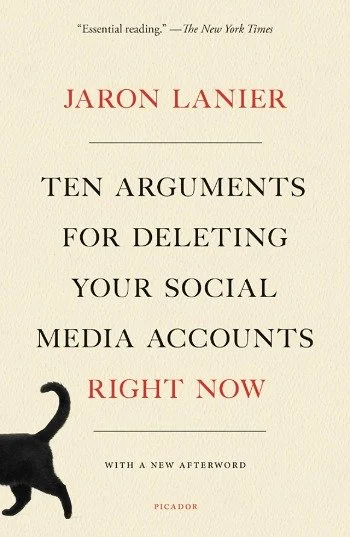
While the premise of this book is promising, the execution is disappointing. Throughout the book Lanier — although trying to be convincing — came out as a rather whiny writer, his tone was crude, at times childish, and rarely mature and balanced. It felt like a plea to quit social media, rather than a convincing set of arguments that would look at multiple sides of the issue and let you decide. Ironically, throughout the book Lanier mentions that he „doesn’t want to tell us what to do”, and even if his intention may have been so, the way he applied his language showed the opposite — it’s a long and annoying rhetoric with banal arguments, and already halfway through I couldn’t wait to finish it (because I could predict everything he was going to say).
If you put it side by side to Newport’s Digital Minimalism (which I’ve also reviewed), it pales in comparison. While Newport’s book is a more balanced and better written set of arguments, Lanier’s book seems like a long-winded rant which lacks substance and style.
I don’t want to be totally negative though, so I’ll bring up the points that I thought were useful in this book. Here’s some notes I made:
1. Social media uses behavioral science to manipulate us (adaptive algorithms, randomness, social feedback, novelty effect).
2. Negative feedback is stronger than the positive one (negative news, shocking / clickbait titles, a.k.a „misery porn”)
3. Ads used to change their format after running and seeing stats (which took a long time); now with social media and behavioral data, they adjust themselves before running, taking into calculation behavioral changes of their target-market. Companies that don’t use this behavioral data feel like they’re being left behind, so in a way „they have no choice”.
That’s pretty much it, the rest is clutter and repetition that could be summarized into a few blog posts. The book lacked multiple viewpoints and it barely mentioned any scientific papers, instead it felt like a rant that could’ve been much sweeter if it was shorter and more to the point.
Also, his obsession with a certain politician (I’ll give you a hint: 2016 U.S. presidential election) is so annoying it overshadows any good points in this book.
Lastly, Lanier is quite pro-censorship, which seemed contradictory to me, based on some other views he had in this book (like romanticizing the early „free” internet). And his patronizing tone just pissed me off too many times to take him seriously. He needs to take a course or two on persuasion, for real.
Rating: 2/5