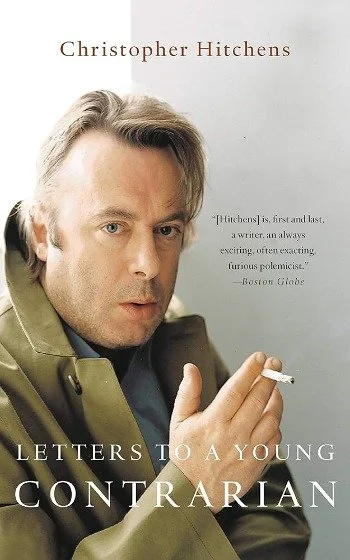
Christopher Hitchens: Letters to a Young Contrarian - book review
“For the moment, do bear in mind that the cynics have a point, of a sort, when they speak of the ‘professional nay-sayer.’ To be in opposition is not to be a nihilist. And there is no decent or charted way of making a living at it. It is something you are, and not something you do” (p. 12).
It is not easy to be against the current and you should not expect praise or appreciation. Being against the current is more about an internal call, a deep, unconscious need to assert yourself, to understand. The rest of this is superfluous: fame, hatred, or indifference from others. Socrates, Galileo, Émile Zola, Kierkegaard felt it on their skin—the appreciation or hatred of the masses is changeable, depending on the cultural and historical context; respectively, people's reaction is often an inconsistent barometer and only causes you more confusion if you decide to base your life on their reactions.
The heretic, by definition, is also arrogant, selfish to some extent. And so, as admirable as a heretic can be, he is often disgusting, repulsive, provocative. Such a person must first be honest with himself, analyzing his own shortcomings and acknowledging the real reasons why he opposes popular opinion—sometimes the reason is a noble one (as when Zola publicly defended Officer Alfred Dreyfus who had been unjustly accused by society), sometimes the reason is mere selfishness. In Orwell's words, "All writers are vain, selfish, and lazy, and their motives are a mystery".
There are also people who put themselves in the opposition just for the sake of opposing, to look more "cool", more "rebellious", but if their opposition has no substance, if it is not based on concrete principles, then they look even more embarrassing than conformists, they massacre and caricature the essence of a heretic—to give the world an alternative view of reality and to encourage them to think critically.
Such people are nihilists, cynical opportunists who let themselves be led by cultural waves, but do not offer something original. They are contemporary "rebels"—a product of capitalism that turns any virtue into a product on the market.
These are some central motives from Hitchens' book, a book written in a letter format to… a young contrarian (surprise surprise!). At first, Hitchens criticizes how the entertainment industry helps minimize the means of appreciating the act of rebellion:
“To be called ‘satirical’ or ‘ironic’ is now to be patronised in a different way; the satirist is the fast-talking cynic and ironist merely sarcastic or self-conscious and wised-up. When a precious and irreplaceable word like ‘irony’ has become a lazy synonym for ‘anomie,’ there is scant room for originality” (pp. 2-3).
But, as he further mentions: “It’s too much to expect to live in an age that is actually propitious for dissent. And most people, most of the time, prefer to seek approval or security. Nor should this surprise us (and nor, incidentally, are those desires contemptible in themselves)” (p. 3).
We should also not forget that “The life of an oppositionist is supposed to be difficult” (p. 3).
Hitchens refers to a tendency that is common, that causes people to become complacent: the saying that we should have “everything in moderation” or that “the truth is somewhere in between”. This, although sometimes true, is too often a lazy excuse for not engaging in debate and for not “offending” anyone.
Indeed, there is a right place and time for moderation and appreciation of the so-called "grey area", but sometimes under the seemingly noble urge to be more moderate there are petty reasons for manipulation and influence:
“On some grave questions, there is no difference to be split; one does not look for a synthesis between verity and falsehood; the sun does not rise in the east one day and in the west the next. (…) If you care about the points of agreement and civility, then, you had better be well-equipped with points of argument and combativity, because if you are not then the ‘center’ will be occupied and defined without you having helped to decide it, or determine what and where it is” (p. 21).
In other words, don't be a "fence-sitter" just for the sake of civility, or for the sake of "stability". Sometimes disagreement is needed (if it is supported by an argument), because we—in Hitchens' words —"make progress by conflict and in mental life by argument and disputation” (p. 20).
It is also a reminder for myself to analyze my arguments, especially since I tend to be centrist in many things. If my centrism has no clear arguments, but only exists under the pretext of maintaining peace between two camps (a thought that is sometimes erroneous) then I am a coward, a man without attitudes and purpose.
Hitchens also gives the example of ancient Greek society, when the oracle at Delphi suggested "not wanting too much." Today this translates as "everything in moderation", which is not exactly the same thing. The Greeks appreciated symmetry and balance, but if that balance is gone, then what's the point of moderation?
In the introduction of the book, Hitchens said something that stuck with me: “I attack and criticise people myself; I have no right to expect lenience in return.”
That is the essence of authentic contrarianism, and, accordingly, the central message of this book. To be a contrarian is to be honest with yourself first and foremost, it means to rebel against the masses if and when it is justified, but at the same time, to rebel is to expect to look stupid and out of touch. There’s no “golden mean” in this, like Aristotle would suggest, no, to be a contrarian is to live from one extreme to the other, from being adored to being hated—sometimes both at the same time. And most of all, to be a contrarian means to have convictions of your own, even when your pursuit appears to be soul-destroying and the desired results seem out of reach:
“The great reward, if that’s the right word, lies in the people you will meet when engaged in the same work, the lessons you will learn, and the confidence you will acquire from having some experiences and convictions of your own—to set against the received of thirdhand opinions of so many others” (p. 126).
There’s something very Kantian about this approach, and it’s no surprise since Hitchens is a big supporter of the Enlightenment age. I would even call it “empirical journalism”—something which we really lack nowadays (when your strongest beliefs are made from first-hand experiences and are bound to constant revisions based on new evidence). This empiricism of his is especially evident when looking at his changing political beliefs throughout his life.
The rigor with which Hitchens attacked controversial topics seemed, at times, very cold, “too scientific” one would even say, but I think beneath that dry British humor and sarcastic digs was a kind soul, one that would even show signs of “weakness” when encountering real-life experiences that would cause him to have cognitive dissonances.
One time when he displayed this “weakness”, or as he said, “the moment in my life of which I’m the most proud” was his trip to Bosnia during the Balkan wars in the 90’s, when the Bosnian Muslims in particular were attacked by the two main waring parties, Serbia and Croatia. That war culminated “with some 10,000 men and boys being butchered after the surrendered of Srebrenica, while superpower satellites recorded proceedings from overhead and while the commander in chief of the pogromists was being received by Western and Russian diplomacy as a partner in peace” (p. 134).
He recalls a specific moment:
“Bosnian official propaganda took an internationalist tone; it described Milosevic’s army and auxiliary death squads as ‘Chetniks”—an old antifascist term—rather than as ‘Serbs’. ‘Death to Fascism’—not a bad slogan—was inscribed on posters everywhere. I still have, framed on my wall, a modest poster that was too intricate for wall-poster display and that I found in a government office that was hit by a mortar shell a few moments after I left it. Gens Una Summus (‘We are one people’) was the superscription. Beneath was a design that incorporated the Catholic and Orthodox crucifixes, the Star of David and the Star and Crescent. Just for once, I thought, It’s OK to represent diverse peoples by religious symbols” (p. 133).
It was a conflict which showed the complexity and innate contradictions in human conduct:
“The attempt to destroy the Muslims of Bosnia took place in broad daylight, and was captured on film, and was the cause of the war and not a vile subtext of it” (p. 129).
The contradiction was the fact that Hitchens dived into a conflict which had such a strange mix of opposing parties and ideologies within the same Bosnian side, that one would wonder if on another day they would be at war with each other: many men and women fighting on the Bosnian side were Serbian and Croatian oppositionists, some were Muslims, some were Orthodox, some were Catholics (I remind you that Hitchens was a huge critic of any religion), there were hard Lefties and there were ones that leaning on the Right of the political spectrum. In spite of those facts, they were all united in fighting for Bosnia’s integrity:
“There were a few gaunt and sectarian and fundamentalist types on the scene, and there were some gangsterism and corruption too, but these things were debated openly and much criticised, and were thought of as letting down the cause rather than exemplifying it. More important still, in a way, was the fact that Serbian and Croatian oppositionists and democrats, half-stifled by a miasma of superstition and xenophobia in their ‘own’ societies, looked on the defense of Bosnia as a survival issue for their own cause as well” (p. 133).
Hitchens mentions the war and how he behaved as a journalist in this situation in order to bring up two important points about being a contrarian:
1. “You may have to be pompous, as well as boring”.
He’s referring to the fact that most people won’t care about your causes and it is expected. Nevertheless, if you believe in it, you should pursue it and assume all the risks that come with it (including embarrassment).
2. “Do not worry too much about who your friends are, or what company you may be keeping. Any cause worth fighting for will attract a plethora of people: I have spoken on platforms with Communists about South Africa and with ‘Cold Warriors’ about Czechoslovakia; and in the case of Bosnia I spoke with Muslims who disagreed with me about Salman Rushdie [he had a bounty on his head, fatwā, issued by the leader of Iran] and Jews who suspected me because I have always supported statehood for the Palestinians. Nor did we agree to bury these disagreements, though we sometimes moved them to a higher plane. (I remember Susan Sontag very bravely, in front of a pro-Bosnian audience that was heavily Turkish, insisting on the parallel with Armenia [genocide].)” (p. 135).
These two lessons are crucial in understanding what it means to be authentic when you rebel against something: it has to come from your own conviction, your own conclusions that you’ve made from observing the evidence—tribal allegiance or patriotism and whatnot has nothing to do with it. That’s what I took from it and I deeply agree with Hitchens’ view on this.
The ability to discern facts from your emotional allegiance to a tribe is what makes us different from most animals, the ability to use our reason. Those rebels and dissidents that fought for a right cause represent a certain tension that never seems to disappear in human history: it’s what I call the tension between truth and tribe.
Hitchens points out a similar thing when he gives the example of his friend who was a Vietnam veteran:
“I think often of my late friend Ron Ridenhour, who became briefly famous when, as an American serviceman in Vietnam, he collected and exposed the evidence pf the hideous massacre of the villagers at My Lai in March 1968. One of the hardest things for anyone to face is the conclusion that his or her ‘own’ side is in the wrong when engaged in a war. The pressure to keep silent and be a ‘team player’ is reinforceable by the accusations of cowardice or treachery that will swiftly be made against dissidents. Sinister phrases of coercion, such as ‘stabbing in the back’ or ‘giving ammunition to the enemy’, have their origin in this dilemma and are always available to help compel unanimity. For resisting this, and for insisting that American officers and men be bound by the customary laws of war, Ron Ridenhour put many people in safer positions to shame. It probably helped, as he once told me, that he himself was the son of a poor white Arizona good ol’ boy family, rather than a bookish or pointy-headed bleeding heart. It all began, in his recollection, when as an uneducated draftee he was lying in his bunk and overheard a group of fellow enlisted men planning a nighttime assault on the only black soldier in the hut. Ron said that he sat up on his own bunk, and heard himself saying, ‘Id you want to do that, you have to come through me.’ As so often, the determination of one individual was enough to dishearten those whose courage was mob-derived. But remember, until the crucial moment arrived he had no idea that he was going to behave in this way” (p. 9).
I particularly liked Hitchens conclusion from his decades of travelling to conflict zones as a journalist:
“In one way, travelling has narrowed my mind. What I have discovered is something very ordinary and unexciting, which is that humans are the same everywhere and that the degree of variation between members of our species is very slight. This is of course an encouraging finding; it helps arm you against news programs back home that show seething or abject masses of either fanatical or torpid people. In another way it is a depressing finding; the sorts of things that make people quarrel and make them stupid are the same everywhere. (…) Freud was brilliantly right when he wrote about ‘the narcissism of the small difference’: the distinctions that seem trivial to the visitor are the obsessive concern of the local and the provincial minds” (p. 107).
In the end, I’ll leave you with Hitchens’ own perfect summary:
“Distrust compassion; prefer dignity for yourself and others. Don’t be afraid to be thought arrogant or selfish. Picture all experts as if they were mammals. Never be a spectator of unfairness or stupidity. Seek out argument and disputation for their own sake; the grave will supply plenty of time for silence” (p. 140).
Rating: 4.5/5