Dave Itzkoff: Robin - book review
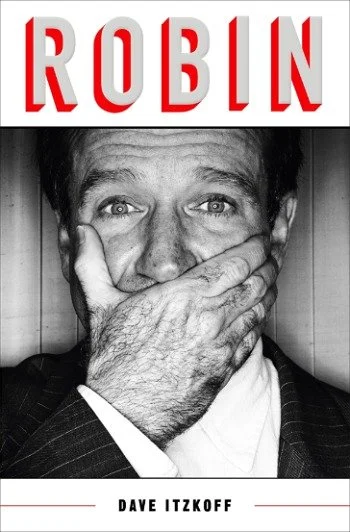
“And when he was gone, we all wished we’d had him just a little bit longer.”
A wonderful audiobook—a bit too slow in the first few chapters (too impersonal and too much Wikipedia-style info), but once it picked up, it made you laugh, wonder and even understand this weird and fascinating man a little more. The book didn't let go until the very end, which was naturally quite a sad one.
If you look at Robin's life, even superficially, it is not entirely wrong to say that he was an alien—you can't compare him to other comics or actors. He has created a genre of his own: a fast-paced, relentless and witty delivery, sarcastic yet warm, inviting yet distant from his own inner turmoil. One could say that he used comedy in order to connect to people, to shield his anxiety with personas and characters, and that would be a cliché,—a comic who is depressed—and still, it would be true. His feeling of never being good enough pushed him to great heights, he made a whole world happy, but he didn't seem happy himself.
I remember seeing one of his stand-ups on YouTube and being in awe of how utterly impressive it was— I knew him as an actor first and foremost, seeing lots of his movies in my childhood, so it was a revelation to me, to see this side of him. I dug into his history and fond out how he rose to prominence. It's fair to say that it brought a few more layers on top of the admiration I already had for this unusual man.
Like most successful comics, comedy was a tool he used to entertain his closest people. In his case, he entertained his mom:
“My mother was funny with me, and I started to be charming and funny for her, and I learned that by being entertaining, you make a connection with another person.”
“What drives you to perform is the need for that primal connection,” he later explained.
His stand-up act seemed like improvisation, but it was carefully crafted; the illusion of spontaneity was part of his genius. It was expertly planned, the whole persona of Robin, with all its caricatures and voices and jokes, it was all shaped and molded in order to create the appearance of coming up with it on the spot. That amount of repetition and learning to deal with failure was surely due to discipline. Robin was humble whenever he explained his craft, and he never liked talking about himself. But it was clear that even if he had some innate talent, he had to work on it a lot and he had to make sacrifices.
The appreciation for discipline in his work he got from his dad, who was never a touchy-feely kind of guy and who only really opened up to Robin once he was on his deathbed. Like most parents at that time, he was a more pragmatic man, who wasn't very enthusiastic when he heard about Robin's desire to pursue a career in comedy. He told him to learn a trade, like welding for example. Funny enough, Robin did attend welding classes, and he actually liked it.
But it had to be comedy from the start. Even so, he did have quite a few serious roles when he was older (Dead Poets Society, Good Will Hunting, to name a few), which, in my opinion, showed his range, showed his ability to access the darker parts of his life and bring it on screen. Yes, he had his critics, and the most common critique was that Robin was playing the same character in every movie. I disagree, but hey, to each its own.
This darker part of him was reflected in his chaotic personal life—cocaine, women and alcohol. He surely wasn't a monk, and he surely had some madness in him. But then all geniuses were a bit mad. As Nietzsche would say, "One must still have chaos in oneself to be able to give birth to a dancing star."
This madness, while fueling his creative work, also caused him to have constant anxiety—he wanted to be liked, he was his own worst critic, and he made some poor life choices as a result. He was always on the move, he never really took roots—maybe only after his heart surgery, after which he gained a new understanding of his own mortality and started to appreciate every human interaction he had (as cliché as that sounds). Before that though, his personal life was quite a mess by societal norms.
Here's the author, Dave Itzkoff, reflecting on Robin's life:
“It was how Robin had been taught to live since childhood: nothing is permanent, transition is constant. Anywhere can be home and anyone can be family, and you can always start over again in new places, with new people. Though it might seem a strange, even insensitive attitude to some, it reflected the essential way Robin saw the world. Reality was a medium that he could shape and manipulate, not some fixed and rigid thing; the temperament that made him spontaneous and capable of astonishing comic insight also made him unconcerned with traditional boundaries and accepted norms [..] Robin was a genius, and genius doesn't produce normal men next door who are good family men and look after their wives and children. Genius requires its own way of looking at and living in the world, and it isn't always compatible with conventional ways of living.”
Robin wasn't normal, but part of him wanted to be so, he wanted to be understood by others, but he didn't like conflict, so he tried to please. He made others laugh and he got better at it. Yet there was always this sense of loneliness in him, there was always a shield that came between his inner self and the outer world.
He once said: “I used to think the worst thing in life is ending up all alone. It isn’t. The worst thing in life is ending up with people that make you feel all alone."
Billy Crystal, his closest friend, reflected Robin's whole personality in a bittersweet speech a few years ago. I think it's a fair conclusion to this review and a beautiful love letter to a comedic genius:
"He made us laugh. Hard. Every time you saw him, on television, movies, nightclubs, arenas, hospitals, homeless shelters, for our troops overseas, and even in a dying girl’s living room for her last wish. He made us laugh, big time. I spent many happy hours with Robin onstage. I mean, the brilliance was astounding, the relentless energy was kind of thrilling. I used to think that if I could just put a saddle on him and stay on for eight seconds, I was going to do okay.
Robin, Whoopi, and I were once in Shea Stadium, in the broadcast booth with the great Tim McCarver. It was comic-relief day for the New York Mets. Robin knew nothing about baseball. I asked him, 'What’s your favorite team?' And he said, ‘The San Franciscoes.’ So he was a little lost in the conversation, so I got an idea and I said, 'You know, Tim, we have a great Russian baseball player with us.' I looked over, his eyes got all bright, his ears perked up like he was a little dog that was inside all day and the master came and said, 'Hey, you want to go for a walk?' So I said, 'What’s baseball like in Russia?' Without missing a beat, he said, 'Well, we’ve only got one team: the Reds.' Well, the next pitch, the batter fouled one off and it came screaming back at us, we ducked down, it slammed against the wall. Robin turned around and bounced it into his hands, and then he stood up and screamed, 'I love America. I’m going to defect.' He could be funny anywhere.
We were such close friends. He would come to all of our great family functions: weddings, bar mitzvahs, that kind of thing. He would sit with my older immigrant relatives like he was one of the guys. And he would tell them about his journey from his little shtetl in Poland to America. One uncle of mine said, 'I came to America after World War II and I hitchhiked.' And Robin said, 'I waited until there was a 747 and a kosher meal.'
Well, as genius as he was onstage, he was the greatest friend you could ever imagine: supportive, protective, loving. It’s very hard to talk about him in the past because he was so present in all of our lives. For almost 40 years, he was the brightest star in the comedy galaxy. But while some of the brightest of our celestial bodies are actually extinct now, their energy long since cooled, but miraculously, because they float in the heavens so far away from us now, their beautiful light will continue to shine on us forever. And the glow will be so bright, it’ll warm your heart, it’ll make your eyes glisten, and it’ll make you think to yourselves: Robin Williams, what a concept."
Rating: 4/5