Jorge Luis Borges: The Lottery of Babylon - short story review
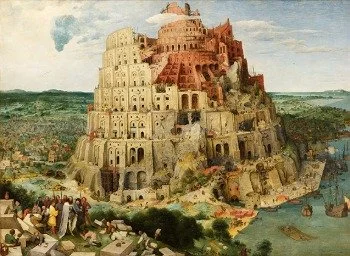
A fascinating little story (or philosophical thought-experiment) in which an unreliable narrator is waiting for a ship to sail as he's rushing to tell us about a mysterious lottery in Babylon that influences our world to this day—we believe the universe is a random generator of things, of circumstances, of fate, of luck, call it whatever you want—it all started there, in The Lottery of Babylon, initiated by a secretive "Company"; yes, it's very conspiratorial, and yes, it's great.
"I have known what the Greeks did not: uncertainty." declares the narrator, alluding to how the Ancient Greeks saw the world as an ordered cosmos managed by Gods, as he begins the story of how The Lottery was introduced (which by definition is defined by chance, not by right and wrong).
"My father related that anciently—a matter of centuries; of years?—the lottery in Babylon was a game of plebeian character. He said (I do not know with what degree of truth) that barbers gave rectangular bits of bone or decorated parchment in exchange for copper coins. A drawing of the lottery was held in the middle of the day: the winners received, without further corroboration from chance, silver- minted coins. The procedure, as you see, was elemental."
But these lotteries did not last, they were boring and there was no real risk involved, no danger. So someone made a small but important reform: introduce a "punishing ticket" for each 30 favored numbers—a sort of Russian roulette to get your pulse go up. And it worked, soon enough, most Babylonians were hooked on this lottery—suddenly, everyone wanted to participate, and those who didn't were frowned upon:
"This slight danger—for each thirty favored numbers there would be one adverse number—awoke, as was only natural, the public's interest."
Then it got more complicated, the winners needed to be protected, and the losers punished, so a certain "Company" was born, a seemingly faceless organization which managed The Lottery:
"The Company (thus it began to be known at that time) was forced to take measures to protect the winners, who could not collect their prizes unless nearly the entire amount of the fines was already collected. The Company brought suit against the losers: the judge condemned them to pay the original fine plus costs or to spend a number of days in jail. Every loser chose jail, so as to defraud the Company. It was from this initial bravado of a few men that the all- powerful position of the Company—its ecclesiastical, metaphysical strength—was derived."
The stakes kept getting higher and higher, and people were getting more and more anxious as a result (sound familiar?):
"The just anxiety of all, poor and rich alike, to participate equally in the lottery, inspired an indignant agitation, the memory of which the years have not erased."
But then, naturally, as the stakes went up, chaos ensued: more crime, more blood, more conspiracies, more hatred among individuals. The solution? The Company gained more public power to bring more order. "This unification was necessary, given the vastness and complexity of the new operations".
I like how Borges alludes to the modern bureaucratic language in this passage:
"Incredibly enough, there were still complaints. The Company, with its habitual discretion, did not reply directly. It preferred to scribble a brief argument—which now figures among sacred scriptures—in the debris of a mask factory."
There's obvious analogies with the real world—corporations or governments with complex machineries gaining more power to control "the chaos", because, on average, people like the idea of freedom more than the actual freedom:
"Improbable as it may be, no one had until then attempted to set up a general theory of games. A Babylonian is not highly speculative. He reveres the judgments of fate, he hands his life over to them, he places his hopes, his panic terror in them, but it never occurs to him to investigate their labyrinthian laws nor the giratory spheres which disclose them."
Also, the whole of idea of our lives dictated by chance, although not original, is portrayed here as a conspiracy with a back story which has infiltrated our daily lives. In Babylon, the sale of tickets for money is abolished, and "every man participates in the sacred drawing of lots". Soon enough, the lottery becomes a metaphor for our lives—we don't willingly participate in it, we automatically participate in it by the simple act of living:
"In the second place, it forced the lottery to be secret, free, and general. The sale of tickets for money was abolished. Once initiated into the mysteries of Bel, every free man automatically participated in the sacred drawings of lots, which were carried out in the labyrinths of the gods every seventy nights and which determined every man's fate until the next exercise."
But the comedy (and absurdity) of this is that not every lottery ticket is "important", and that many "drawings" that are handed to us are absolutely insignificant (or are they?):
"There are also impersonal drawings, of undefined purpose: one drawing will decree that a sapphire from Taprobane be thrown into the waters of the Euphrates; another, that a bird be released from a tower roof; another, that a grain of sand be withdrawn (or added) to the innumerable grains on a beach. The consequences, sometimes, are terrifying."
Moreover, "the number of drawings is infinite", which means that no decision is final—life is not a movie, there is no conclusion (well, except death).
This "Company" (God? Religion? Fate? Illuminati? Google? Your Mom?) has influenced our lives in such a way that "our customs have become thoroughly impregnated by chance." And it's true in our lives as well, just ask any stock broker—they believe in magic numbers that always change, because they yell and make serious faces and make deals and stuff (*broker voice*: "those magic numbers are real dude, it's all real, profits brotha, profiiiiitsssss")
But then, in typical Borguesian self-irony, the (unreliable) narrator suggests that maybe this story is bullshit after all:
"I myself, in making this hasty declaration, have falsified or invented some grandeur, some atrocity; perhaps, too, a certain mysterious monotony. . . ."
Got to love how Borges builds intricate worlds in a short amount of time then trolls the reader at the end with "meh, maybe not". Ha, what a guy.
"This silent functioning, comparable to that of God, gives rise to all manner of conjectures. One of them, for instance, abominably insinuates that the Company is eternal and that it will last until the last night of the world, when the last god annihilates the cosmos. Still another conjecture declares that the Company is omnipotent, but that it exerts its influence only in the most minute matters: in a bird's cry, m the shades of rust and the hues of dust, in the cat naps of dawn. There is one conjecture, spoken from the mouths of masked heresiarchs, to the effect that the Company has never existed and never will. A conjecture no less vile argues that it is indifferently inconsequential to affirm or deny the reality of the shadowy corporation, because Babylon is nothing but an infinite game of chance."
Rating: 4/5